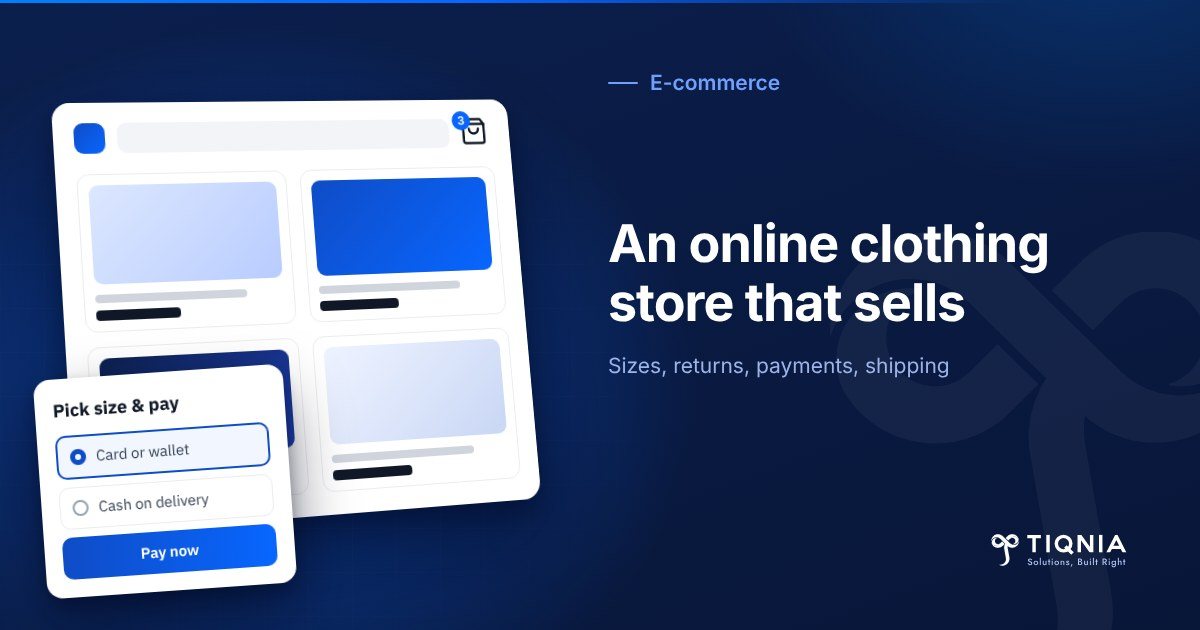
Building an online clothing store in Egypt that actually sells takes five things working together: a platform that handles sizes and colours as variants, product pages with a real size guide and honest photos, a written exchange policy shown before checkout, cash on delivery next to cards and wallets, and shipping connected to a courier such as Bosta or Aramex. Good looks alone don't sell clothes.
Clothing is not like other products. One T-shirt in five sizes and four colours is twenty separate stock items. The shopper can't touch the fabric or try it on, so they buy while worrying about fit. That is why fashion stores deal with more exchanges and returns than most categories.
This guide is for owners of an established brand or shop, selling on Instagram, from a branch or several, who want a store that works as a real sales channel. It covers the decisions to make before you talk to any agency, and the questions that prevent surprises after launch.
Key takeaways:
- Sizes and colours must be variants, each with its own SKU and stock count.
- A per-item size guide and model photos with the size worn are the best tools against returns.
- Egyptian law gives shoppers 14 days to exchange or return, so build your policy around it.
- Cash on delivery is still essential in Egypt; pair it with WhatsApp order confirmation.
- A catalog synced to Meta and Google turns ad spend into measurable sales.
What makes a clothing store different from other online stores?
A clothing store differs in four ways: variants (size and colour for every style), high return rates driven by fit, heavy reliance on photography, and seasons that turn over stock every few months. A platform or design that ignores any of these will hurt you within the first month.
An electronics shop might list 50 products as 50 codes. A fashion brand with 50 styles can easily reach 500 or 1,000 stock-keeping units. That affects everything: page speed, how products are uploaded, sales reports and syncing stock with a physical branch.
So when you ask for a quote, don't just say "we need a store". Say how many styles you have, how many sizes and colours per style, and how often you drop a new collection. Those numbers shape the whole project, and they drive the cost of building and running an online store as well.
WooCommerce, Shopify or custom build for a fashion brand?
The right choice depends on your size and on whether branches and stock need to connect. WooCommerce gives full ownership and flexible local payments, Shopify removes hosting and updates from your plate, and a custom build makes sense when your business logic doesn't fit either.
When WooCommerce fits a clothing brand
Choose it if you want full control, need Egyptian gateways such as Paymob, Kashier or Fawry without an extra platform fee, and have a team or agency to handle updates and hosting. Because it runs on WordPress, content and SEO are very flexible.
When Shopify fits better
Choose it if speed to launch matters and you don't want to manage servers, and you accept that part of your running cost is in US dollars. There is an important catch for the Egyptian market, which we cover in our WooCommerce vs Shopify guide.
When you need a custom build
When you run several branches with shared stock, need a mobile app, sell wholesale and retail at different prices, or must connect to an existing accounting system. Then the store is one part of a bigger system, which is the kind of work we do in our e-commerce service.
Sizes and colours: how to build a clothing product page
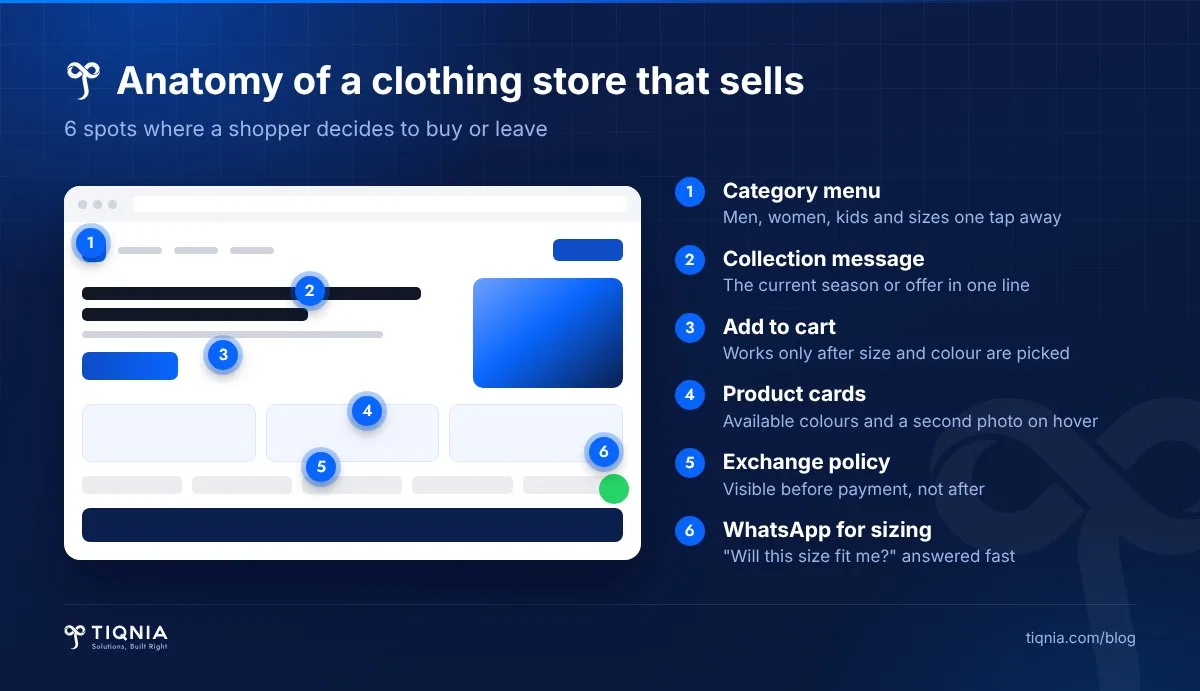
A clothing product page must answer one question before anything else: "Will this fit me?" If the shopper can't find the answer quickly, they either leave or buy with a plan to return.
Variants and a SKU for every piece
Each style is one product with variants for every size and colour. Each variant has its own SKU, stock and image. When a shopper picks "Blue – L" they see the blue photo and know immediately if it's sold out. A common mistake is uploading each colour as a separate product, which breaks reports and confuses shoppers.
The size guide
Give a size chart in centimetres for each garment type (T-shirt, trousers, dress), not one generic chart for the whole store. Add a line such as "Model is 180 cm and wears size M". That one sentence saves dozens of WhatsApp questions.
Photos and video
Front, back and a close-up of the fabric, a photo on a model where possible, and a short video that shows how the fabric moves. Keep every image the same ratio and background so category pages look tidy. Compress them well: a fashion store with thousands of images can become very slow on mobile.
Returns and exchanges: write the policy before your first sale
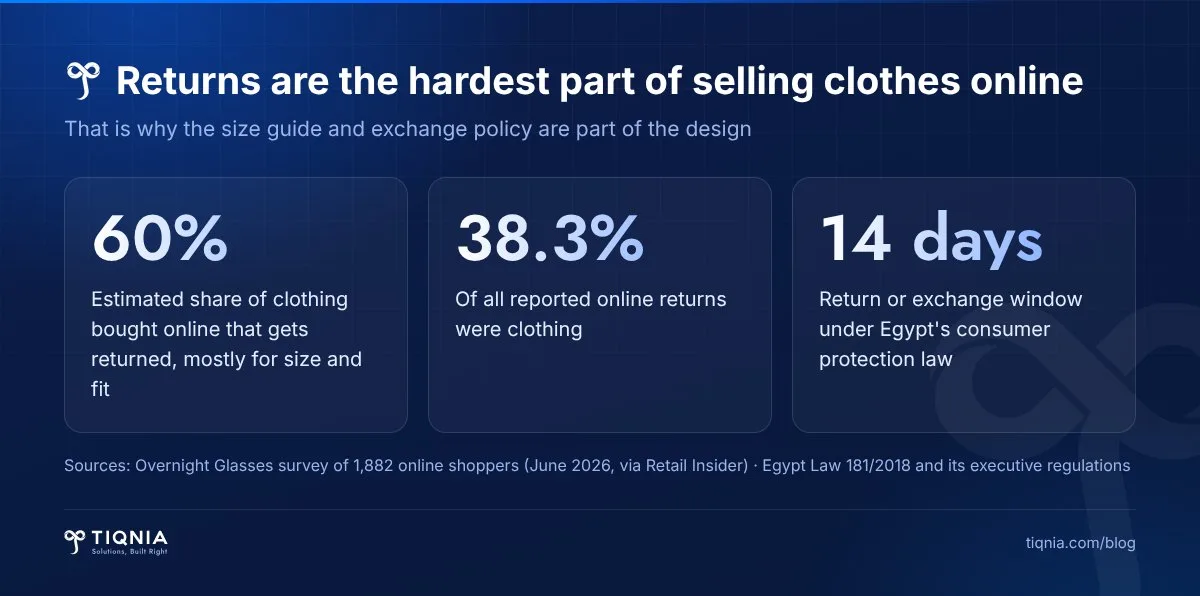
Returns are the biggest hidden cost of selling clothes online. A survey of 1,882 online shoppers by Overnight Glasses, reported by Retail Insider in July 2026, estimated that about 60% of clothing bought online is returned, that clothing made up 38.3% of all reported returns, and that sizing is the main reason. These are international figures, but the lesson applies everywhere.
In Egypt, the law already sets part of your policy. Consumer Protection Law No. 181 of 2018 and its executive regulations give the consumer 14 days from delivery to exchange or return goods without giving a reason, with exceptions such as made-to-order items and underwear or wedding dresses once unwrapped, as Al Mal News reported citing the Consumer Protection Agency.
What your exchange policy should state
- The window in days and when it starts (the delivery date).
- Item condition: tags on and unworn.
- Excluded items, stated clearly and in line with the law.
- Who pays exchange shipping in each case.
- How refunds are paid: original method, card, wallet or store credit.
Show the policy on the product page and in the cart, not buried in the footer. Rules and enforcement change, so have your lawyer review the wording before launch.
Cash on delivery or online payment for an online clothing store in Egypt?
Both. Cash is still the dominant payment method in Egypt: the US International Trade Administration's Egypt guide (updated November 2025) says only 10–12 million Egyptians hold a credit or debit card, under 10% of the population. For most clothing stores, cash on delivery is not optional.
The downside is more orders refused at the door. To reduce them:
- Confirm every order on WhatsApp before it ships, automatically or through customer service.
- Show online payment first: cards, InstaPay or Vodafone Cash through a gateway such as Paymob, Kashier or Fawry.
- If you reward prepayment, make it visible in the cart.
- Track door refusals by governorate and adjust confirmation or shipping rules.
Gateway fees change and depend on your agreement, so get them in writing from the gateway before you calculate margins.
Shipping and exchanges with Bosta and Aramex
For a fashion store, the courier does more than deliver. It collects cash and handles returns, so connecting it to the store saves a lot of manual work. An integration means each order is created at the courier automatically, the tracking number reaches the customer, and the status updates in your admin panel.
Ask a courier three things before signing: do they offer exchange at the door (deliver the new size and collect the old one in the same visit)? When do they transfer collected cash? What does a returned shipment cost? Those answers affect profit more than the delivery fee itself.
Connecting your clothing store to Instagram, Facebook and Google
Most Egyptian fashion brands sell on Instagram and Facebook before they have a store. The store does not replace social media. It is where your ads land and where you measure who actually bought.
Meta catalog and pixel
Syncing your product catalog to Meta Commerce Manager lets you run ads that show shoppers the exact items they viewed. The Pixel together with the Conversions API tells Meta who purchased, so campaigns learn and improve. Without them you pay for ads without knowing which ones sold.
Google Merchant Center
Google has specific rules for apparel. According to Google Merchant Center Help, apparel offers need gender, age group and colour, and shoes also need size. Variants are grouped with the item_group_id attribute. If the store is built correctly from day one, that data flows out automatically, which is the groundwork for Google and Meta ads management after launch.
Have a shop or branches? Connect stock from the start
The worst moment in a clothing store is when a customer pays for a size, and you then find the last piece sold in the branch that morning. The fix is for the store and the branches to see the same stock, by connecting the store to your POS and accounting system.
Make this decision before the store is built, not after. Connecting a finished store to a branch system later is much harder and more expensive than building it connected. If you have branches, ask any agency: "How will stock sync between the store and the branch? Live or once a day?"
What we have learned building fashion and brand stores
At TIQNIA, a Dokki-based team working with companies in Egypt and Saudi Arabia, we built the Cottonil online store, including its Qatar store, for a clothing brand selling in more than one market. We have also built Shopify stores for brands such as Ylights, Linah Farms and Mr Beard, and for 7Pets we brought 9 branches into one sales operation: online store, app and POS.
What we've learned is that clothing store problems rarely sit in the design. They sit in how variants are uploaded, how stock moves between branches, and unclear exchange rules. So every store we build starts with a session on styles, sizes and shipping before any page is drawn. You can browse our portfolio of stores and sites.
We work as one accountable team: a named project manager, a weekly written update and support after launch. If the lowest price is your top priority, we are probably not the right fit. If you'd like to talk about your store, message us on WhatsApp.
A practical checklist before you request a quote
Prepare these before the first meeting and you'll get a more accurate proposal and a shorter build:
- The number of current styles, and the typical sizes and colours per style.
- A size chart in centimetres for each garment type.
- Product photos: ready, or still to be shot? (Photography is done with a specialist photographer and is separate from building the store.)
- A written, reviewed exchange and return policy.
- The payment methods you want, and whether you already have a gateway account.
- Your courier, and whether it supports exchange at the door.
- Any branches or accounting system that must connect to the store.
- Meta Business and Google Merchant Center accounts, and whose name they are in.
One last point: the domain, hosting and ad accounts should be registered to your company, not to anyone who works for you.
The bottom line
An online clothing store succeeds on details shoppers never see: correctly built variants, connected stock, a clear exchange policy, and integrated payments and shipping. Design matters, but these are what keep sales coming. If you want your brand's store built this way, tell us what you need or message us on WhatsApp, and we'll scope the proposal once we understand your business.
FAQs
What is the best platform for an online clothing store in Egypt?
There is no single best one. WooCommerce suits brands that want full ownership and Egyptian gateways without an extra platform fee, Shopify suits a fast launch without managing hosting, and a custom build suits brands with shared stock across branches or an app.
Do I need cash on delivery for a clothing store in Egypt?
In most cases yes, because cash is still the dominant payment method and fewer than 10% of Egyptians hold a bank card. Offer online payment first and confirm cash-on-delivery orders on WhatsApp before shipping.
How many days do customers have to return clothes in Egypt?
Consumer Protection Law No. 181 of 2018 and its executive regulations give consumers 14 days from delivery to exchange or return without a reason, with exceptions such as made-to-order goods and unwrapped underwear. Have a lawyer review your policy wording.
How can a clothing store reduce size-related returns?
Publish a size chart in centimetres for each garment type, state the model's height and size worn, show several photo angles, and offer WhatsApp support for sizing questions before purchase.
Can I connect my clothing store to Instagram and Facebook?
Yes. Sync your product catalog to Meta Commerce Manager and install the Pixel with the Conversions API, so ads can show shoppers the exact items they viewed and you can see which ads produced sales.
Can my online store share stock with my physical shop?
Yes, by connecting the store to the POS and accounting system your branch uses so both see the same stock. Decide this before the build, because adding it later is harder and more expensive.
Tell us what you need and the TIQNIA team will come back with a clear plan.