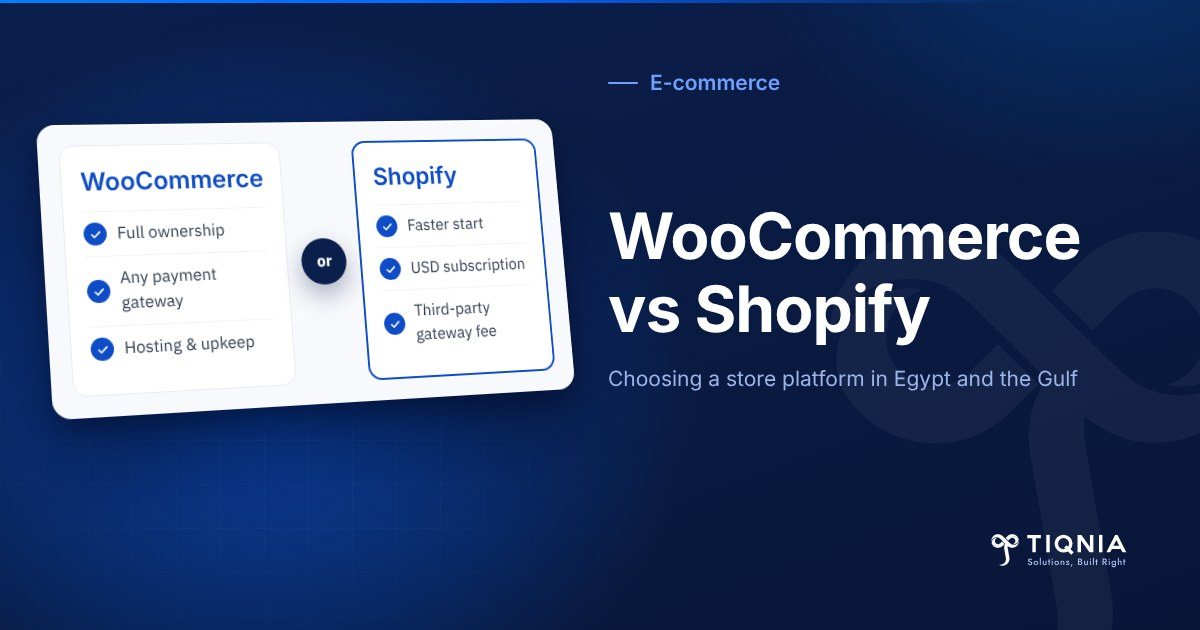
If you're weighing WooCommerce vs Shopify for a company store in Egypt or the Gulf, here is the short answer: Shopify is faster to launch and takes hosting and maintenance off your plate, but it bills in US dollars and adds a fee when you use a local payment gateway. WooCommerce gives you full ownership and lets you connect any gateway or system, but it needs a team to run and secure it.
Most comparisons ranking on Google are written for merchants in the US or Europe. They talk about Stripe, PayPal and Shopify Payments as if everyone can use them. A business in Cairo or Riyadh has different questions: will we collect through Paymob or Fawry? How does cash on delivery work? What happens to the budget when the subscription is in dollars and the pound moves?
This guide compares the two platforms from that seat: payments, real running costs, ownership, Arabic storefronts, connecting to stock and branches, and who keeps the store running after launch. It ends with four questions that usually settle the decision.
Key takeaways if you're short on time:
- Shopify is a hosted platform on a monthly plan; WooCommerce is a free WordPress plugin you host yourself.
- Shopify Payments isn't available in Egypt, so you'll use a third-party gateway and Shopify adds 2%, 1% or 0.6% depending on the plan.
- WooCommerce charges nothing extra for third-party gateways, but needs solid hosting and ongoing maintenance.
- If the store must sync with branch stock or accounting, flexibility usually matters more than an easy start.
- Start the decision from how you get paid and who runs the store, not from the theme.
WooCommerce vs Shopify: what is the core difference?
The core difference is that Shopify is a service you rent and WooCommerce is software you own. Almost every other difference, from cost to customization to maintenance, follows from that.
Shopify: a ready store on a monthly plan
Shopify is a SaaS platform: you pay a subscription and Shopify handles hosting, security and updates. You pick a theme, upload products, add apps from the app store and start selling. There is no server to manage.
WooCommerce: an open-source plugin for WordPress
WooCommerce is a free plugin that turns a WordPress site into a store. The code is open, the site sits on hosting in your name, and you can change anything. In return, hosting, updates, backups and security are your responsibility, or your support partner's.
In Egypt the two are almost level. According to AfterShip's Egypt e-commerce statistics, each platform runs roughly 38% of the stores it tracks. There is no universally wrong choice, only a choice that doesn't fit your operation. That is where our e-commerce service starts: understand the business first, then recommend the platform.
Payments in Egypt and the Gulf: the deciding factor
How you collect money is the first thing to settle, because Shopify Payments, Shopify's built-in gateway, is not available in Egypt. That means using a third-party gateway, and Shopify charges an extra fee on every transaction that goes through one.
Shopify's third-party gateway fee
According to EasySell's guide to Shopify gateways in cash-on-delivery markets (April 2026), Shopify Payments covers 39 countries and Egypt is not one of them. With a third-party gateway, Shopify adds 2% on Basic, 1% on Grow and 0.6% on Advanced, on top of the gateway's own commission.
A simple example: a store selling EGP 1 million a year online on the Basic plan sends EGP 20,000 to Shopify in that fee alone, before the gateway takes its cut. The figure grows with your sales, so put it in the margin from day one.
Local gateways and mada in Saudi Arabia
In Egypt, ask your gateway directly whether it has an official Shopify app. For Saudi Arabia and the Gulf, the same guide names PayTabs and Tap Payments as Shopify options that support mada, Apple Pay and STC Pay. WooCommerce is wider open: Style Factory's comparison (July 2026) counts 48 supported payment processors and no platform fee on third-party gateways.
Cash on delivery
Cash on delivery is still a large share of orders in Egypt. Both platforms support it: on Shopify you add it as a manual payment method in settings; on WooCommerce it's built in. The real work is elsewhere: collecting cash from the courier, confirming orders before shipping, and settling returns.
WooCommerce vs Shopify cost: a USD subscription or hosting and upkeep?
Shopify looks cheaper at first because everything sits inside one plan; WooCommerce looks cheaper because the software is free. Both have ongoing costs. They are just billed differently.
- Shopify: current 2026 sources quote different figures for the Basic plan, from about $25 to $39 a month depending on the source and on monthly or annual billing, so check the official pricing page before you budget. Apps come on top, mostly as monthly USD subscriptions.
- WooCommerce: the plugin is free, but Ecosire's comparison (September 2026) puts hosting for most stores at $25 to $350 a month depending on size. Paid extensions usually renew yearly, and someone has to do the maintenance.
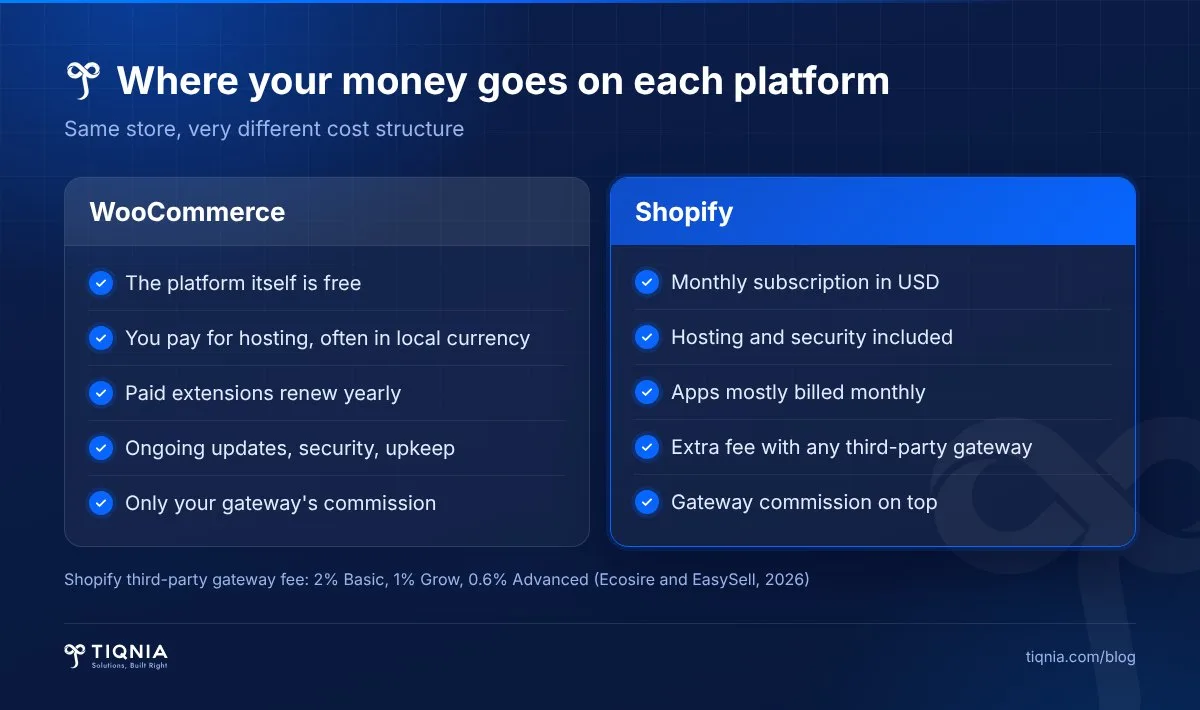
One point matters a lot in Egypt: nearly all Shopify costs are in dollars, so your budget moves with the exchange rate. With WooCommerce you can choose hosting and a support partner that bill in local currency, which keeps most of the cost predictable.
If you're budgeting the whole store, not just the platform, see how we build online stores, from checkout to shipping, and read what drives website design cost in Egypt if you also need a corporate site next to the store.
Ownership and control: is the store really yours?
With WooCommerce you own everything: the code, the data and the hosting are in your name, and you can move to any server or provider. With Shopify you own your products, customers and orders, but the store itself lives on a platform you rent and runs on its terms.
That isn't a flaw; it's how any SaaS works. But ask yourself:
- If you switch platforms in three years, can you export products, customers and orders cleanly?
- If you need a feature no app provides, what is the plan?
- If a subscription payment fails, what happens to the store?
On either platform, make sure every account is in your company's name, not the developer's: the Shopify account, or the hosting and domain for WooCommerce. It's the first thing we check when a client asks us to take over a store.
Arabic, RTL and SEO: which suits an Arabic store?
Both platforms can run a good Arabic storefront; the result depends more on the theme and setup than on the platform. WordPress has supported right-to-left layouts for years and many themes handle it well. On Shopify, confirm the specific theme handles RTL properly, because not all of them do.
An Arabic and English store
Shopify handles multiple languages through Markets, up to 20 languages according to Style Factory. WooCommerce relies on plugins such as WPML. Both work; what matters is that each page has its counterpart and the versions are linked correctly so Google knows which page serves which language.
SEO for the store
SEO is less a platform feature than work done on the store: a unique title and description for each product, clean URLs, mobile speed and original content. WooCommerce gives you more control over URLs and code; Shopify gives you a solid base with some fixed URL patterns. On either, a slow store with copied product descriptions won't rank.
Products, variants and connecting stock and branches
If the store is online-only with a reasonable catalogue, either platform will do. The difference shows when the store is part of a company with a warehouse, branches, a POS and an accounting system.
- Sizes and colours: Shopify allows 3 options per product and up to 2,048 variants, according to Style Factory. That covers most stores, but products with many options need planning.
- Branches and POS: Shopify has its own POS, and the POS Pro add-on is billed per location per month in dollars. With WooCommerce you connect the store to the POS and stock system you already use.
- Shipping: couriers such as Bosta and Aramex need an integration that creates the waybill and updates order status. Confirm it exists for your platform before you decide.
- Wholesale pricing: if you sell to traders at special prices, WooCommerce or a custom build is usually easier.
Who runs the store after launch? Maintenance and security
On Shopify, security, updates and hosting are the platform's job, and you focus on products and orders. On WooCommerce, someone must update WordPress and plugins, take backups, and watch speed and security on a schedule.
That explains most WooCommerce problems we see: a store built well and then left untouched for a year. An old plugin with a vulnerability, an update that broke checkout, or cheap hosting that went down on a sale day. If you choose WooCommerce, agree up front on after-launch support and who is responsible for what.
When to choose WooCommerce and when to choose Shopify
Choose Shopify if you want to launch fast with a small team and a simple catalogue. Choose WooCommerce if the store must connect to your company's systems, needs real customization, or should keep dollar costs low.
Shopify fits if:
- You have no technical team and don't want to deal with hosting or updates.
- Your catalogue is fairly small and you sell online only.
- You sell to several countries and want multi-currency out of the box.
- Your margin can absorb the subscription and the third-party gateway fee.
WooCommerce fits if:
- The store must sync with branch stock, accounting or a POS.
- You want any Egyptian gateway without an extra platform fee.
- You have custom selling logic: wholesale, bundles, customer-specific prices.
- You want full ownership, mostly local-currency costs, and you have a support partner.
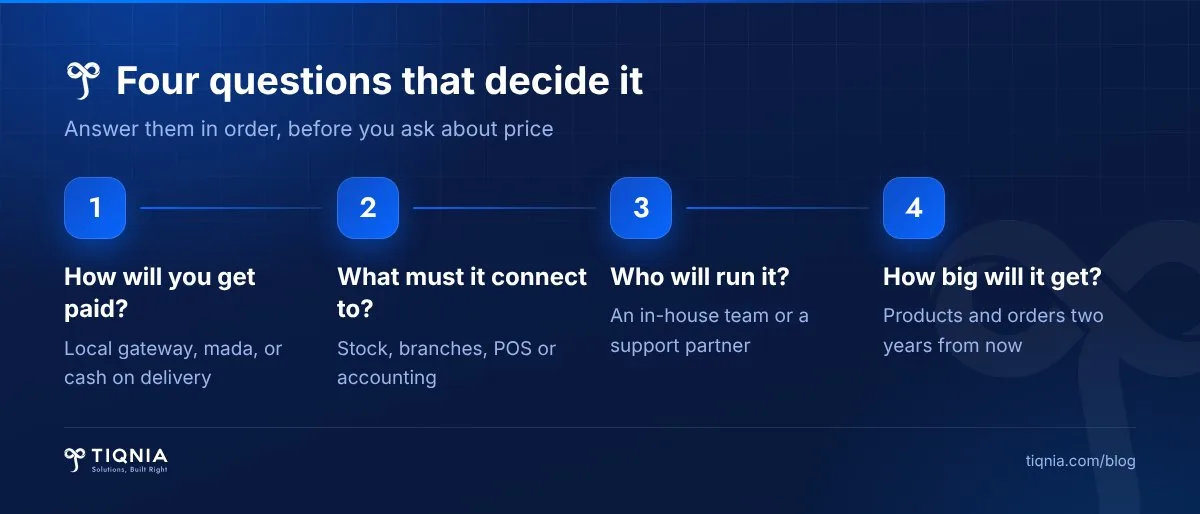
If you need more than either can give, such as complex pricing rules or a mobile app sharing the same stock, a custom store built on Laravel or React makes sense, which we handle through our software solutions.
From our experience at TIQNIA: we build on both
At TIQNIA, a technology company in Dokki working with businesses in Egypt and Saudi Arabia, we build stores on WooCommerce, on Shopify, and as custom Laravel and React builds. That lets us recommend the platform that fits the client's operation, not the one we're used to.
Shopify stores we delivered include Ylights, Linah Farms and Mr Beard. With 7Pets the brief was bigger than a store: 9 branches unified into one sales operation, with an online store, an app and a POS. In cases like that, the connection to stock and branches decides the platform, not the theme. You can browse our portfolio of stores and websites.
We connect gateways such as Paymob, Kashier, Fawry, InstaPay and Vodafone Cash, and couriers such as Bosta and Aramex. And if the lowest price is your top priority, we're probably not the right fit.
Still torn between the two? Message us on WhatsApp and tell us what you sell and how you get paid.
Questions to ask any agency before choosing a platform
Before you sign, ask for written answers to these. An agency that answers them clearly usually knows what it's doing.
- Why did you recommend this platform for my business specifically, not for stores in general?
- Is our payment gateway officially integrated with the platform? What is the full fee per transaction, including any platform fee?
- How will cash on delivery and courier cash collection work?
- Will every account, platform, hosting and domain, be in my company's name?
- Which subscriptions and extensions will I pay for monthly or yearly after launch, and in which currency?
- Who handles updates and backups, and for how long?
- If I change platforms later, how do I take my products, customers and orders with me?
The bottom line
WooCommerce vs Shopify has no single answer: Shopify is easier to start and is paid in dollars and per transaction; WooCommerce is more flexible and cheaper in fees, but needs someone to run it. Start from how you get paid and which systems the store must connect to. For a specific recommendation, tell us what you need, see the WooCommerce and Shopify stores we build, or reach us on WhatsApp and we'll come back with a clear recommendation.
FAQs
Which is better for a store in Egypt, WooCommerce or Shopify?
Neither wins everywhere. Shopify suits a small team that wants to launch fast without managing hosting; WooCommerce suits a company that must connect the store to stock, branches or an Egyptian gateway without an extra platform fee.
Is Shopify Payments available in Egypt?
No. According to EasySell (April 2026), Shopify Payments covers 39 countries and Egypt is not among them, so Egyptian Shopify stores use a third-party payment gateway.
What does Shopify charge when I use a third-party gateway?
Shopify adds 2% on Basic, 1% on Grow and 0.6% on Advanced to every transaction through a third-party gateway, on top of the gateway's own commission. Fees can change, so confirm on Shopify's pricing page.
Is WooCommerce really free?
The WooCommerce plugin is free and open source, but a store still needs a domain, hosting, usually some paid extensions, and ongoing updates and maintenance by your team or a support partner.
Can I offer cash on delivery on Shopify and WooCommerce?
Yes. Shopify adds it as a manual payment method in settings, and WooCommerce has it built in. The real work is order confirmation, courier cash collection and handling returns.
Can I move from Shopify to WooCommerce, or the other way, later?
Yes. Products, customers and orders can be exported and imported either way, but the theme, apps and URLs are rebuilt, and old URLs need redirects so you keep your Google rankings.
Tell us what you need and the TIQNIA team will come back with a clear plan.