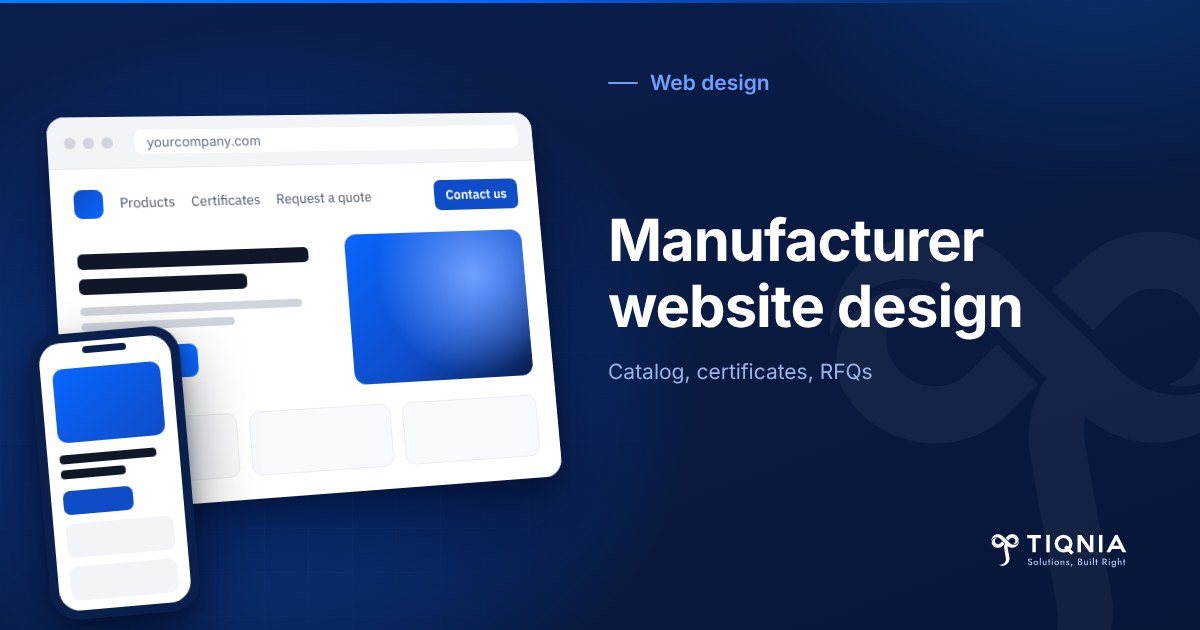
Good manufacturer website design turns your site into a source of qualified quote requests, not an online brochure. That means a product catalog with real specifications and downloadable datasheets, visible quality certificates, an English version written for export buyers, and a request-a-quote form plus a sales WhatsApp button on every product page.
Most manufacturers in Egypt and the Gulf still treat their website as a company profile. Meanwhile, the procurement manager comparing three or four suppliers wants answers without picking up the phone: what exactly you make, to which specs, in what quantities, and where you ship.
This guide covers who actually visits a factory website, the pages you need with a ready sitemap, how to build a catalog and quote form that work, how to prepare for export and search, common mistakes, and a checklist to use with any agency.
Short on time? The five points that matter:
- A manufacturer's website exists to generate requests for quotation (RFQs), not just to show the production line.
- Every product gets its own page: specs, sizes, applications and a downloadable datasheet.
- A "Request a quote" button and sales WhatsApp belong on every product page.
- Certificates and export markets are shown with real documents and dates, no exaggeration.
- If you export, the English site is written for foreign buyers and wired correctly, never machine-translated.
Who visits a manufacturer's website, and what are they looking for?
A factory website serves three visitors: the procurement manager or engineer at a company that buys from you, the distributor or trader who wants to resell your products, and the foreign importer. Each arrives with a different question, and a good site answers all three.
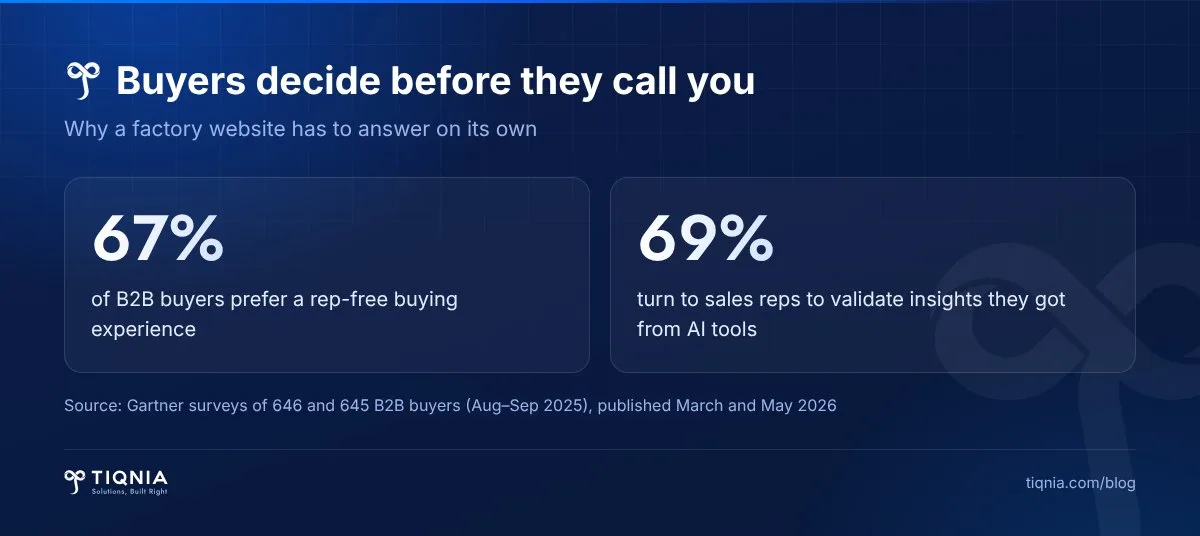
Buyers increasingly prefer to do that research alone. A Gartner survey published in March 2026 found that 67% of B2B buyers prefer a rep-free buying experience. Your website is effectively your first salesperson, and it often works before anyone on your team knows a buyer is comparing suppliers.
Procurement managers and engineers
They need precise technical data: material, dimensions, tolerances, the standards the product complies with, and the minimum order quantity. They download the spec sheet and drop it into a comparison file. If the specs aren't there, you never make the shortlist.
Distributors and traders
They are looking for margin and reliable supply. They want to see the product range, packaging and carton details, and how to become an authorised distributor in their area. A "Become a distributor" page with a clear form saves your team a lot of calls.
Foreign importers
They read in English and look for certificates, production capacity, the countries you already export to, and shipping terms. Any sign that the site is abandoned or machine-translated makes them close the tab.
Manufacturer website design: which pages do you need?
A manufacturer website needs eight core pages: home, products, industries served, quality and certificates, the factory and capacity, export, distributors, and contact. That is the minimum for a buyer to find answers on their own, and it is the same foundation we start from in our company website service before adding what your business needs.
A sitemap you can start from:
- Home: what you make and for whom in one line, your main product categories, real numbers, and a quote button.
- Products: categories, and under each one a page per product with its specifications.
- Industries: one page per sector you serve (food, construction, pharma, packaging) with the matching products.
- Quality and certificates: ISO and conformity certificates, quality policy and labs.
- The factory: location, area, production lines and capacity if you choose to publish it.
- Export: markets, shipping terms and the documents you provide.
- Distributors: a map or list of distributors and a "Become a distributor" form.
- Contact: RFQ form, sales WhatsApp and the address on a map.
Pages that make a difference on top of that: a download centre with every catalog and datasheet, an About page with the factory's history and management, and a careers page if you hire often.
How should a manufacturer present a product catalog online?
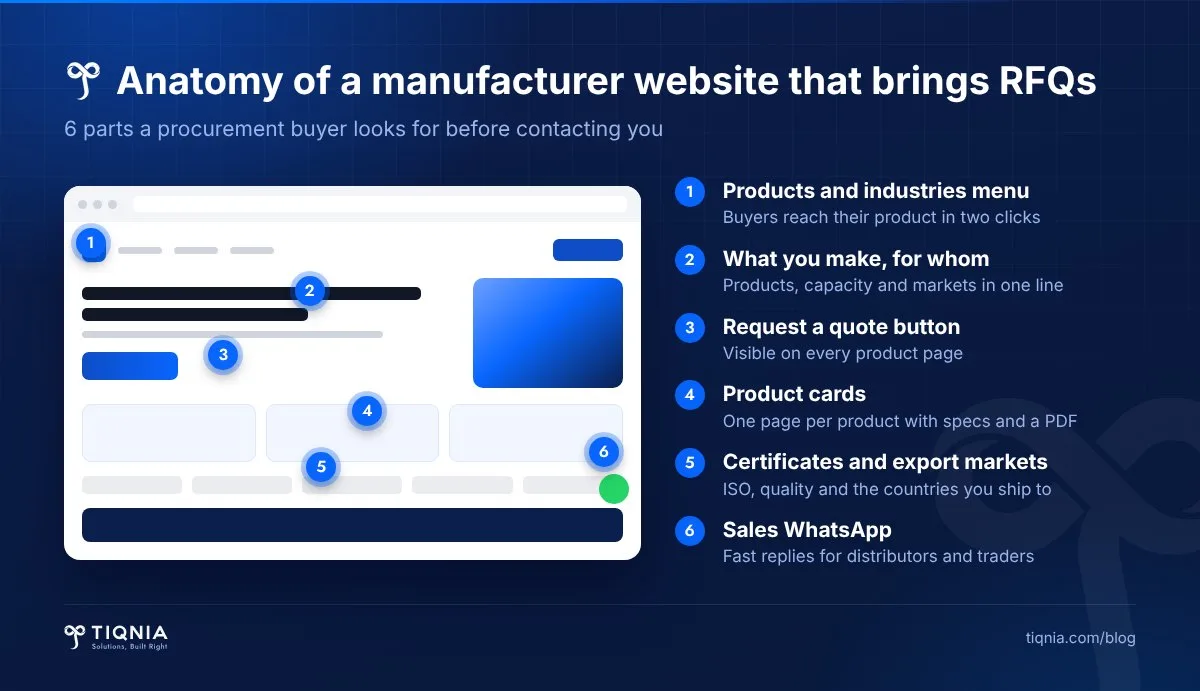
A manufacturer's online catalog should be one page per product, not one large PDF. A dedicated page can rank on Google for the product name, gives the buyer everything in one place, and tells you exactly which product is generating demand.
What belongs on a product page?
- The product name as buyers search for it, not only your internal code.
- Real product photos from several angles, plus a packaging shot.
- Specifications written as text or a list (material, dimensions, weight, colours, standards).
- Applications and the industries the product suits.
- Minimum order quantity and typical lead time, if you publish them.
- A lightweight datasheet or catalog PDF to download.
- A "Request a quote" button that opens the form with the product name pre-filled.
Filters and search
Once you have more than 30 or 40 products, filters become essential: by category, material, size or industry. Engineers search by specification, not by trade name, so make sure search finds both.
An admin panel you control
Factories launch new products and discontinue old ones. If every change requires calling the agency, the catalog goes stale within months. Ask for an Arabic and English admin panel where you can add a product, its specs and its files in minutes.
RFQs and distributors: how does the site generate requests, not just visits?
A manufacturer's website is measured by the number of serious quote requests it brings in, not by traffic. The request-for-quotation (RFQ) form is where a visit turns into a sales opportunity, so it has to be short and smart.
An RFQ form that works
- Name, company, country, and WhatsApp number or email.
- The product (pre-filled from the page) and approximate quantity.
- A file upload field for drawings when products are made to order.
- One optional question: when do you need it?
Every extra field lowers completion. Anything else your sales manager needs can be asked on the first call.
A distributor portal with private pricing
Some factories need more than a form: approved distributors who log in, see their own price lists and place volume orders. That is no longer a brochure site; it is a system, and it is usually built as a second phase once the main site is live. If that is your need, look at our software solutions for custom systems.
More important than the form itself is who receives the request and how fast they reply. Route it to a named sales manager's email or WhatsApp, not a generic inbox nobody checks.
How does a factory website build trust with certificates and quality?
Trust on a factory website is built with evidence: quality certificates shown with their number and expiry date, real photos from the production lines, and customer names or markets you have permission to mention. Serious buyers verify, so any exaggeration is found out quickly.
- Certificates: ISO 9001 or others, conformity certificates, and regulatory registrations if your sector requires them.
- Production: real photos and video of equipment and labs, never stock images.
- Numbers: founding year, area, number of lines, markets, only what you can prove.
- Customers: logos or names with their approval, or sectors without names.
We don't do photography, but we tell you exactly which shots you need and for which page before the photographer visits the factory, so one shoot covers the whole site.
Export-ready manufacturer websites: languages and international SEO
If you export or plan to, a manufacturer website needs at least Arabic and English, each written for its reader. A foreign importer judges your professionalism from the first English paragraph, and machine translation shows immediately.
How should languages be built technically?
Each language gets its own URL (such as /ar/ and /en/), and the pages are connected with hreflang tags, which tell Google that two pages are versions of the same content in different languages. Google explains the setup in its guide to localized versions of pages. If you want to target a third market, add that language to your most important product pages first.
The export page
The export page answers an importer's questions before they ask: the markets you ship to, the shipping terms you work with, the documents you provide, and container-ready packaging. Only list what you actually do.
How do buyers find a manufacturer's website on Google and AI assistants?
Buyers find a manufacturer's website when every product has a clear page with its name and specs, the site loads fast, and the information is structured so search engines and AI tools can read it. That is practical SEO, not a vague promise.
- Product pages: a title and description for each product using buyers' words, like "industrial plastic bag supplier", not "Our products".
- Structured data: Google supports Product structured data, which describes a product's name and attributes to the search engine.
- Speed: product photos are usually heavy, so compress them to WebP and test your pages with PageSpeed Insights.
- Google Business Profile: the factory's listing on Google Maps with address and hours, so buyers searching nearby can find you.
There is a newer factor too: buyers now ask AI tools about suppliers. Another Gartner survey, published in May 2026, found that 69% of B2B buyers turn to sales reps to validate AI-generated insights. The information on your site is being read and compared, and any mismatch with what your sales team says weakens the buyer's trust.
What we've learned building company websites
At TIQNIA (تقنية), a technology partner based in Dokki, Giza, working with companies in Egypt and Saudi Arabia, we have delivered websites, stores and systems for more than 350 companies over 9+ years. Our corporate and brand sites include work for Kohtex, Pharma Treat and Eptaderm, which you can see in our work.
The biggest delay on factory websites is rarely the code. It is gathering content: specs scattered across engineers, outdated photos, certificates in different folders. That is why we start with a clear discovery phase, then design, build, test and launch, then operate and improve.
- Arabic and English site with a full admin panel and training for your team.
- A first design concept with 3 revision rounds, and a delivery date written in the contract.
- A named project manager and a written weekly update.
- 6 months of support after launch, plus domain, hosting and business email for the first year.
If the lowest price is your top priority, we are probably not the right fit. We suit manufacturers who want the site to work as a sales channel and a team that stays with them after launch.
Want to know exactly what your factory's site needs? Message us on WhatsApp and tell us what you make and who you sell to.
Common manufacturer website mistakes and a checklist before you start
Most factory websites we review make the same mistakes, and nearly all are easy to avoid if you know them upfront.
Mistakes we see often
- One large catalog PDF instead of product pages, so Google can't see your products.
- Products with a photo and a name but no specifications.
- No quote button, and the only contact is a landline answered by someone who doesn't know the products.
- A machine-translated or half-finished English version.
- The latest news or product is years old, so the site looks abandoned.
- Domain and hosting registered to the agency, not the factory.
A checklist you can use today
- List the products you most want to sell, and for each one: name, specs, applications and packaging.
- Collect existing datasheets and catalogs and make lightweight versions.
- Scan every certificate and note each one's expiry date.
- Decide who receives quote requests and who answers distributors.
- Choose the markets you want to reach so you can decide on languages.
- Ask any agency: can I add a product myself? Will the site and domain be in my name? Are the languages linked correctly? Is there support after launch?
If you are still comparing agencies, read how to choose a web design company, and if you are budgeting, see what drives website design cost in Egypt.
The bottom line
A strong manufacturer website works like a salesperson who answers around the clock: it presents every product with its specs, proves your quality with certificates, and lets buyers and distributors request a quote in a minute. If you'd like us to build that for your factory, tell us what you need and see how we build company websites, or reach us on WhatsApp and we'll come back with a clear plan.
FAQs
What pages should a manufacturer website have?
A manufacturer website should have a home page, products with one page per product, industries served, quality and certificates, the factory and capacity, export, distributors, and a contact page with a request-a-quote form and WhatsApp.
Should a factory publish its catalog as a PDF or as web pages?
Use one web page per product, with a downloadable PDF on that page. Product pages can rank on Google for the product name and carry the specs and quote button, while a single large PDF is hard for both Google and buyers to navigate.
Does a manufacturer website need an English version?
If you export or sell to foreign or Gulf companies, yes. The English version should be written for foreign buyers rather than machine-translated, with a separate URL per language connected by hreflang tags.
Should manufacturers show prices on their website?
Most manufacturers don't publish public prices because they depend on quantity and specifications, so they use a request-for-quotation form instead. If you have approved distributors, a login portal can show each one their own price list.
What drives the cost of a manufacturer website?
The main cost drivers are the number of products and filters, the number of languages, the admin panel, integrations such as a distributor portal, and preparing content and photos. Ask for a written quote after the agency understands your needs.
Tell us what you need and the TIQNIA team will come back with a clear plan.