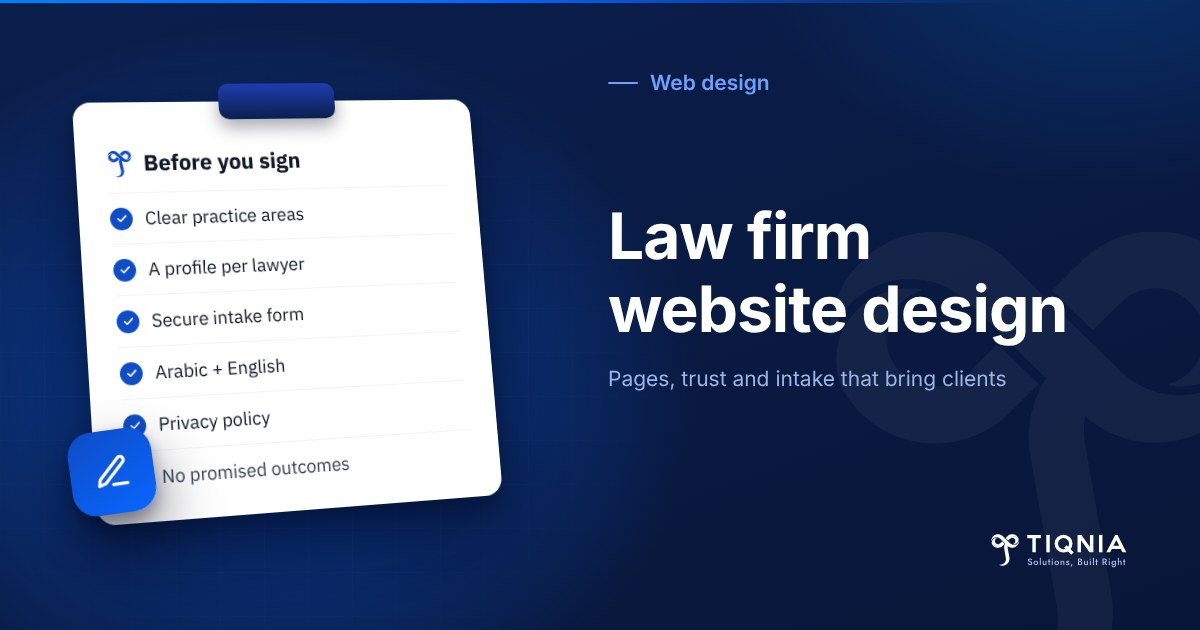
Good law firm website design does one job: it makes a worried prospective client trust you enough to request a consultation. That means a page for each practice area, a real profile for every lawyer, a short secure intake form with WhatsApp in view, an English version if you serve companies or foreign clients, and wording that respects your bar's rules, with no promised outcomes.
People rarely look for a lawyer when life is calm. They have a family dispute, an employment claim, a contract that went wrong or money they can't collect. They compare a few firms on their phone and decide within a minute whether you understand their problem and how to reach you.
This guide covers who actually visits a law firm website in Egypt and the Gulf, the pages you need with a ready sitemap, how to write practice-area pages and lawyer profiles, how to turn a visit into a consultation request, what not to publish, and a checklist to use before you hire anyone to build it.
The short version:
- A law firm site exists to build trust and generate consultation requests, not to show books and scales of justice.
- Every practice area needs its own page explaining the problem, the usual steps and the documents to prepare.
- Response speed matters more than visuals: a short form, visible WhatsApp and routing to the right person.
- Confidentiality is part of the design: a secure form, a privacy policy, and no case details in the first message.
- Never promise results or publish client details; check your wording against your bar's conduct rules.
Who visits a law firm website, and what are they looking for?
Three kinds of visitors land on a law firm website: individuals with a personal legal problem, companies looking for counsel or a firm to handle contracts and disputes, and foreign or Gulf-based clients who need representation in Egypt. Each arrives with a different question, and a good site answers all three without mixing them up.
The individual with a problem
They search in their own words: "family lawyer in Nasr City" or "how to file for alimony". They want to feel the firm understands their situation, know what happens next, and find an easy way to get in touch from their phone. Generic text about "justice and integrity" sends them back to the results page.
The company looking for counsel
A managing director or CFO wants experience in corporate, contracts, employment or tax. They look at the team and its credentials, the kind of companies the firm serves, and whether there's a retainer or ongoing advisory option. This decision takes longer and involves more than one person.
The foreign or Gulf-based client
An investor setting up a company in Egypt, or an Egyptian living in the Gulf with a dispute at home. They usually read in English and need to know the firm works with overseas clients and is comfortable with email and video calls.
What pages does a law firm website need?
A law firm website needs seven core pages: home, practice areas, lawyers, about the firm, articles and FAQs, request a consultation, and contact. That's the minimum for a client to find answers on their own, and it's the same foundation we start from in our company website service before adding what a specific firm needs.
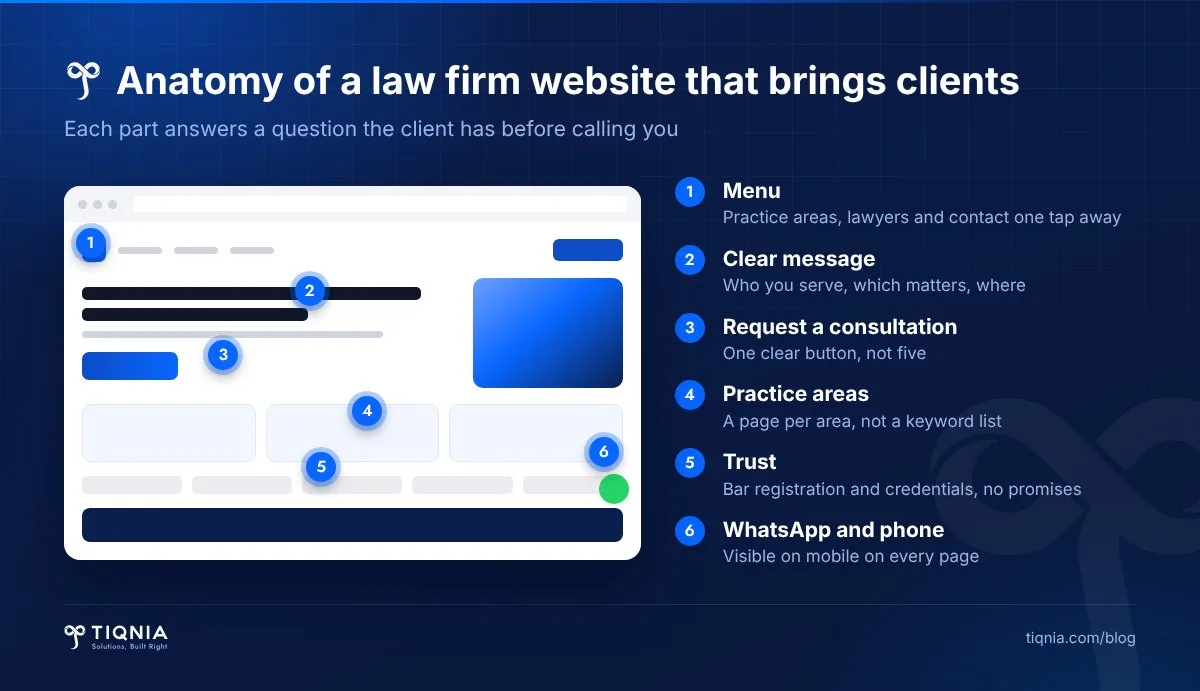
A sitemap you can start from:
- Home: who you serve, in which matters and where, in one sentence, with a consultation button under it.
- Practice areas: an overview page, then a dedicated page for each area.
- Lawyers: a page for each key lawyer with credentials, bar admission and languages.
- About: year founded, how you work, offices and values, without slogans.
- Articles and FAQs: plain answers to the questions your team hears every day.
- Request a consultation: a short form and clear information on the format (in person, online, phone).
- Contact: address with a map, office hours, phone, WhatsApp and email.
Pages that help with corporate clients: a "services for companies" or retained-counsel page, an English page for overseas clients, and a careers and internships page if you take on junior lawyers.
How should you write practice area pages?
A strong practice area page explains the problem in the client's language, the steps to expect, the documents needed and when to call you. These are the most important pages on the site, because they appear when someone searches for their problem and they prove the firm understands it.
What belongs on a practice area page
- A heading in the words people search, such as "employment lawyer", not "Labour Department".
- A short paragraph on what the area covers and who needs it.
- The common situations the firm handles in that area, as a list.
- The general steps from first consultation to follow-up, with no promised timeline or outcome.
- Documents the client should prepare before the first meeting.
- FAQs specific to the area, and a consultation button at the end.
Don't put every area on one page
A page listing 15 practice areas won't rank for any of them. Start with your four or five strongest areas, write them properly and add more later. One page written with real understanding beats ten thin ones.
Lawyer profiles: building trust without overclaiming
Clients hire a lawyer, not a logo. That's why the team page is among the most visited pages on firm websites, and a clear lawyer profile builds more trust than any marketing line.
Google treats legal content as a "Your Money or Your Life" topic, meaning it can affect people's finances and lives, and its guidance on helpful content says it gives more weight to experience, expertise, authoritativeness and trust (E-E-A-T) on such topics. A named author with real credentials and a genuine lawyer page help visibility, not only persuasion.
The ideal lawyer profile
- A real professional photo, not a stock image.
- Qualifications, bar admission level and years of practice.
- Areas of focus and languages spoken.
- Articles they wrote on the site, linked to their name.
- A "request a consultation" button that opens the form with their name filled in.
What to avoid: unsourced win rates, titles like "the best lawyer in Egypt", and client names or case details without written consent. They damage trust and can expose the firm to professional discipline.
Client intake: how does the site turn a visitor into a client?
A law firm website is measured by the serious consultation requests it brings in and how fast they get answered. This is where most firms lose clients: in a Clio mystery-shopper study of 500 law firms, only 40% of firms picked up the phone, 33% replied to emails, and just 30% of shoppers could easily understand the hiring process from the website.
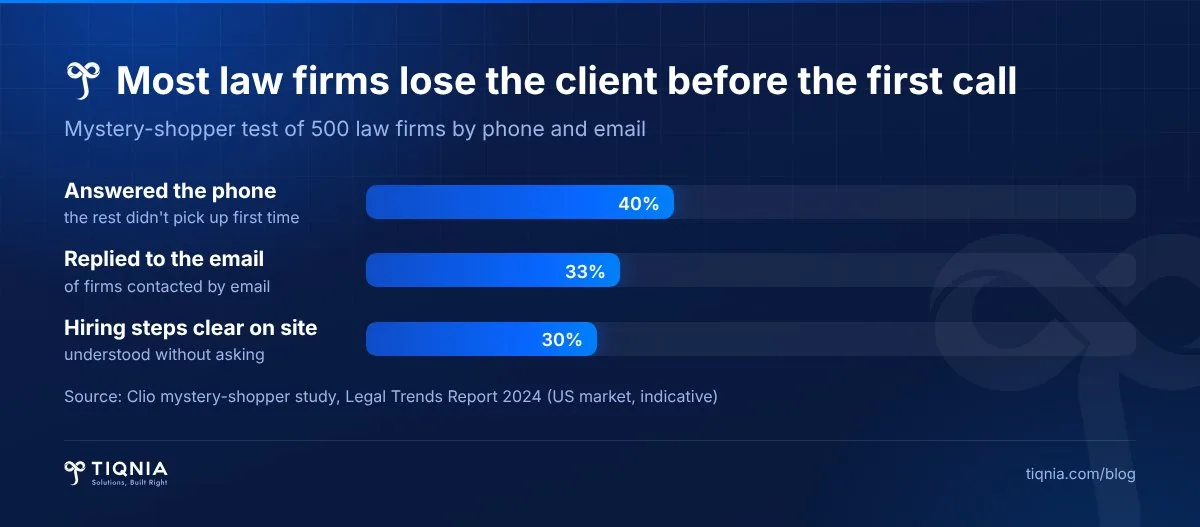
Those figures come from the US market and are indicative only, but the lesson travels: a beautiful site is wasted if requests land in an inbox nobody opens.
An intake form that works
- Name, mobile or WhatsApp number, and email.
- Area of the problem from a list (family, employment, corporate, real estate, criminal…).
- City, and whether they prefer an in-person or online consultation.
- An optional short description, with a note not to share sensitive details yet.
- Consent to the privacy policy.
WhatsApp and response time
In Egypt and the Gulf, WhatsApp is the fastest channel. A sticky WhatsApp button on mobile with a pre-filled message naming the practice area saves the client a step. Every request should reach the responsible person immediately, by email and WhatsApp or in a simple CRM, with an auto-reply telling the client when to expect a call.
Make the hiring steps clear
On the consultation page, explain what happens after they submit: who will call, what the first consultation looks like and which documents to bring. You don't have to publish fees, but a client who understands the steps is far more likely to continue.
Client confidentiality and data protection on the website
Confidentiality on a law firm website isn't a technical detail; it's part of the firm's reputation. Anything a client types into your form is personal data and should be treated that way from day one.
Egypt has its Personal Data Protection Law No. 151 of 2020, and Saudi Arabia has its Personal Data Protection Law overseen by SDAIA. You know the legal detail better than any developer, but the site itself should be built to make compliance easy.
- SSL across the whole site, and forms that only submit over a secure connection.
- A clear privacy policy in Arabic and English: what you collect, why, and who sees it.
- Requests stored in an admin panel with permissions, not a shared general inbox.
- No case-document uploads in the first form unless you have a secure system for them.
- Regular backups and security updates for the site and its plugins.
What shouldn't appear on a law firm website?
Lawyer advertising has professional rules, and the website is part of how the bar and clients see the firm. The general rule: accurate information about the firm and its services, with nothing misleading, no promises and no client confidences.
In Saudi Arabia, for example, the Saudi Bar Association reminded lawyers in November 2026 that self-promotion must not be misleading or overstate qualifications or experience, and that giving detailed answers about pending cases to attract clients breaches the professional conduct rules. In Egypt, review your wording against the Bar Syndicate's rules before launch.
In practice, this is what we remove from any law firm site we work on:
- "We guarantee you'll win" or any promised outcome or timeline.
- Success rates without a clear source.
- Client names, document images or case details without consent.
- Comparisons with, or criticism of, other firms.
- Testimonials written in-house; if you show reviews, use real ones from your Google Business Profile.
Local SEO for law firms: how do clients find you?
Most lawyer searches are local: "lawyer in Maadi", "law firm in Jeddah". Once the site is built properly, local SEO matters most, and it rests on four things.
- A complete Google Business Profile: the firm's real name, the right category, hours, real photos, and polite replies to reviews that never mention case details.
- A page for each office or city you genuinely serve, with its address and map, not duplicated pages for every district.
- Articles answering real client questions in each area, written or reviewed by a named lawyer at the firm.
- Structured data (Schema): LegalService for the firm and FAQPage for questions, so Google and AI assistants understand what the firm does and where.
If you serve foreign or Gulf companies, write the English version for that reader rather than translating word for word, and link it technically to the Arabic version so each language reaches its own audience.
What we've learned building law firm websites
At TIQNIA, a technology partner based in Dokki, Giza, working with established companies in Egypt and Saudi Arabia for more than nine years and over 350 companies delivered, we've built websites for several Egyptian law firms. We don't name them, because confidentiality is part of the work itself.
Three lessons from those projects:
- Content is the bottleneck, not design. Lawyers are busy, and practice-area pages and profiles get delayed. We start with a set question list per area, draft the copy, and leave legal review to the firm.
- English matters with corporate clients. Many firms serve foreign investors, and the English version is often the first thing an overseas partner uses to judge the firm.
- The admin panel has to be easy. A firm that can add an article or update a profile itself keeps its site alive. Our company websites come with an Arabic and English admin panel, training, and six months of support after launch.
You can browse our portfolio across industries. If you'd like to see how your firm's site could be built, message us on WhatsApp and tell us your practice areas.
A law firm website design checklist before you sign
Before you sign with anyone, ask these questions and get the answers in writing in the proposal or contract:
- Are the domain and hosting in the firm's name, with the logins in your hands?
- How many practice-area pages and lawyer profiles are in scope?
- Who writes the content, and who reviews it legally?
- Is the site Arabic and English from day one, and linked correctly?
- Where does the consultation form go, where is it stored, and who can access it?
- Are SSL, a privacy policy and backups included?
- Can you add articles and edit profiles yourself from the admin panel?
- What happens after launch: how many months of support, and who is responsible?
For more questions on choosing the agency itself, read how to choose a web design company, and if you're setting a budget, see what drives the cost of a company website.
The bottom line
A successful law firm website does three things: it builds trust with real information about your lawyers and practice areas, makes requesting a consultation easy and fast, and respects confidentiality and professional rules. Polished design matters, but it comes after those.
We shape the proposal once we understand what your firm needs. To start, tell us what you need, read more about how we build company websites, or send us a WhatsApp message directly.
FAQs
What pages does a law firm website need?
Seven core pages: home, practice areas with one page per area, lawyers, about, articles and FAQs, request a consultation, and contact. Practice-area pages matter most because they are what appears in Google searches.
Can lawyers advertise on their own website?
Publishing accurate information about the firm and its services is normal, but lawyer advertising has professional rules. In Saudi Arabia the Saudi Bar Association requires that self-promotion is not misleading; in Egypt, check the Bar Syndicate's rules. In general, avoid promised outcomes, unsourced success rates and client names.
Should a law firm publish its fees online?
Not necessarily. What matters is explaining the hiring steps: who will contact the client, what the first consultation looks like and which documents to bring. Clients who understand the process are more likely to continue even if fees are set after the consultation.
How do I protect client data submitted through the website?
Use SSL across the site, publish a clear privacy policy, store requests in an admin panel with permissions instead of a shared inbox, and don't ask for case details or documents in the first form. Also check your country's personal data protection law.
Does a law firm in Egypt need an English website?
Yes, if you serve foreign companies, investors or Gulf-based clients. The English version should be written for that reader rather than translated word for word, and linked technically to the Arabic version so each language reaches its audience in Google.
How can a law firm rank in local Google searches?
With a complete Google Business Profile in the right category, a page for each office or city you genuinely serve, articles answering client questions under a real lawyer's name, and LegalService and FAQPage structured data.
Tell us what you need and the TIQNIA team will come back with a clear plan.