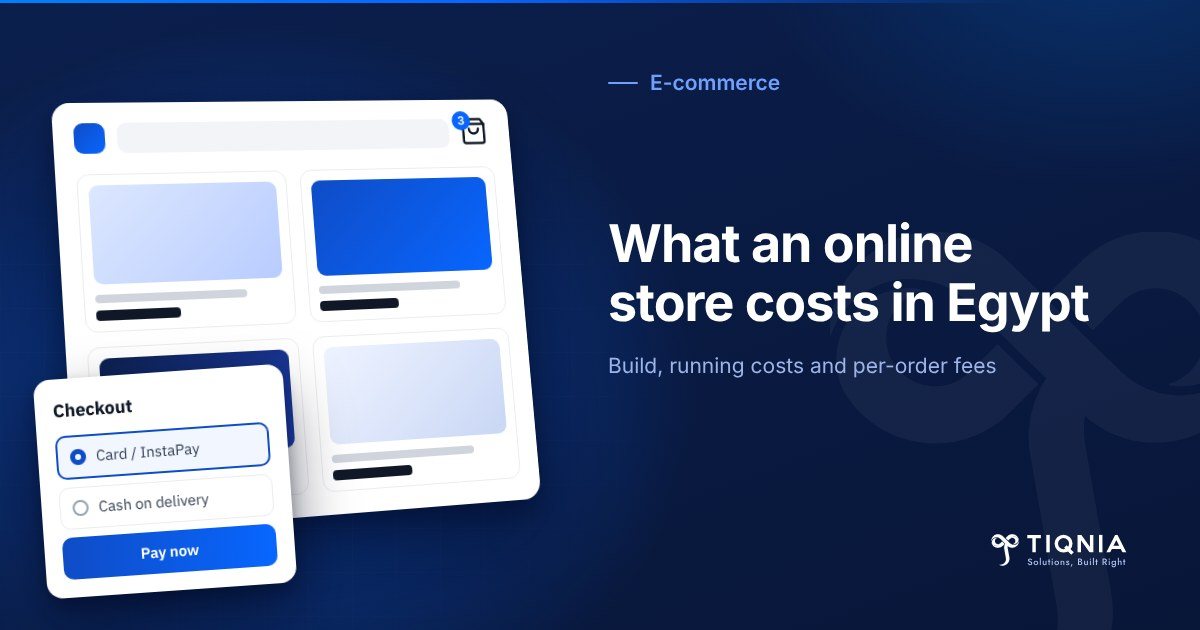
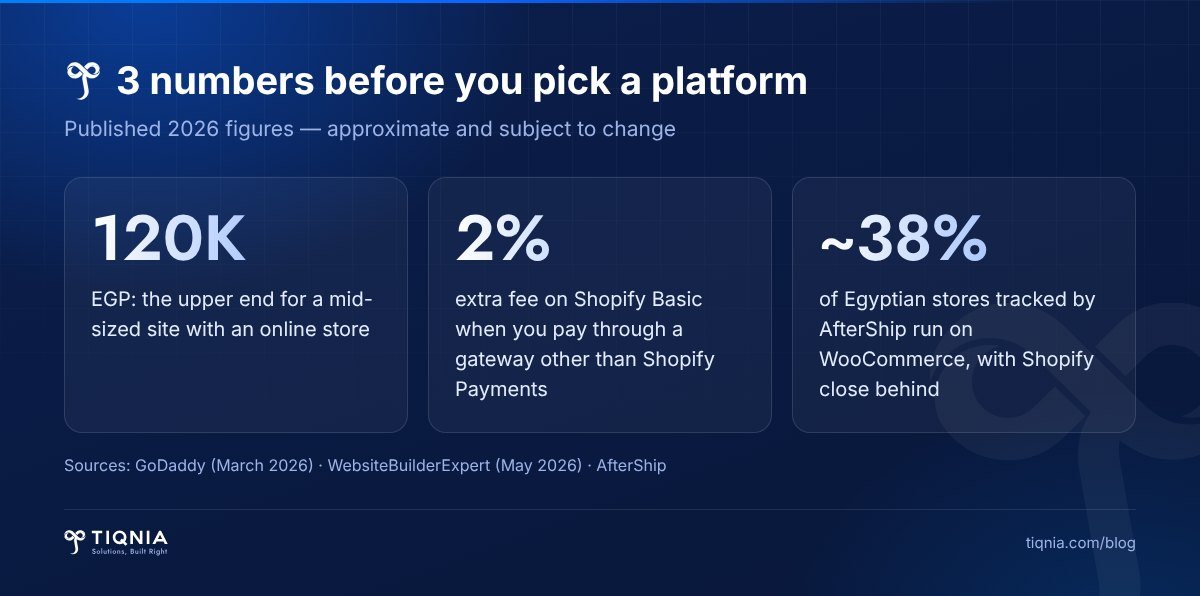
If you are budgeting an online store for your company, here is the short answer: online store cost in Egypt is three costs, not one. There is a build cost you pay once, running costs you pay every month or year (platform, hosting, apps), and fees taken from every order (payment gateway, shipping). A mid-sized store can cost up to about EGP 120,000 to build, according to GoDaddy.
Most buyers compare the build quote and stop there. Six months later they find that the platform subscription is in dollars, the apps renew every year, and every order loses a percentage to the payment gateway and a fixed amount to shipping.
Below you will find published market figures with their sources, how the maths changes between Shopify, WooCommerce and a custom store, the per-order costs, a simple way to budget your first year, and the questions to ask any agency before you sign.
The short version:
- A mid-sized store can cost up to about EGP 120,000 to build in 2026. Treat every figure as approximate; most move with the dollar.
- Split the budget three ways: one-time build, fixed running costs, and per-order fees.
- Shopify is a monthly USD subscription; WooCommerce itself is free but needs hosting, setup and upkeep.
- Online payment processing typically costs 1.5% to 3.5% of each transaction, so build it into your margin from day one.
- The biggest cost drivers are integrations with stock or accounting systems, catalogue size and variants, and custom design.
How much does an online store cost in Egypt in 2026?
There is no single price for an online store, but the market has three clear tiers. These figures are approximate, were checked in November 2026, and vary with catalogue size, platform, integrations and who builds it:
- A DIY store on a hosted platform: SaaS subscriptions start at roughly $30 to $40 a month, according to Shoplazza's 2026 store cost guide. Fine for testing a product; not built for a company with branches and stock.
- A mid-sized company store built by a local agency: GoDaddy's Middle East website cost guide (March 2026) puts a medium site with an online store at up to EGP 120,000, or around SAR 10,000 in Saudi Arabia.
- A fully custom store at global agency rates: DesignRush estimates $10,000 to $20,000+ for a platform store with agency customisation, and $20,000 to $50,000+ for a fully custom build. Those are global agency prices, not a benchmark for the Egyptian market.
All of these figures move with the exchange rate, because a large share of a store's costs is paid in dollars: the platform plan, themes, apps and marketing tools. A number you read today can be out of date in a few months.
If what you need is a company website rather than a store that sells, the maths is different. Start with what drives the price of a company website in Egypt.
Three kinds of cost: once, every month, and on every order
The most accurate way to budget a store is to group costs by when you pay them. It explains why two stores with the same build quote can have very different real costs after a year.
1. Build cost (one-time)
Design, platform setup, product upload, payment and shipping integrations, testing, and admin training. This is the number on the quote, and usually the only one people compare.
2. Fixed running costs (monthly or yearly)
- Domain: roughly $10 to $20 a year, according to Shoplazza.
- Platform plan if you are on Shopify, or hosting if you are on WooCommerce.
- Apps and extensions: $20 to $300 a month depending on what you need, per the same guide.
- Maintenance, updates and technical support.
3. Variable fees (per order)
Payment gateway commission, shipping, cash-on-delivery collection fees and returns. This line is small at launch and grows with every order. It is the one that quietly eats your margin if you do not plan for it.
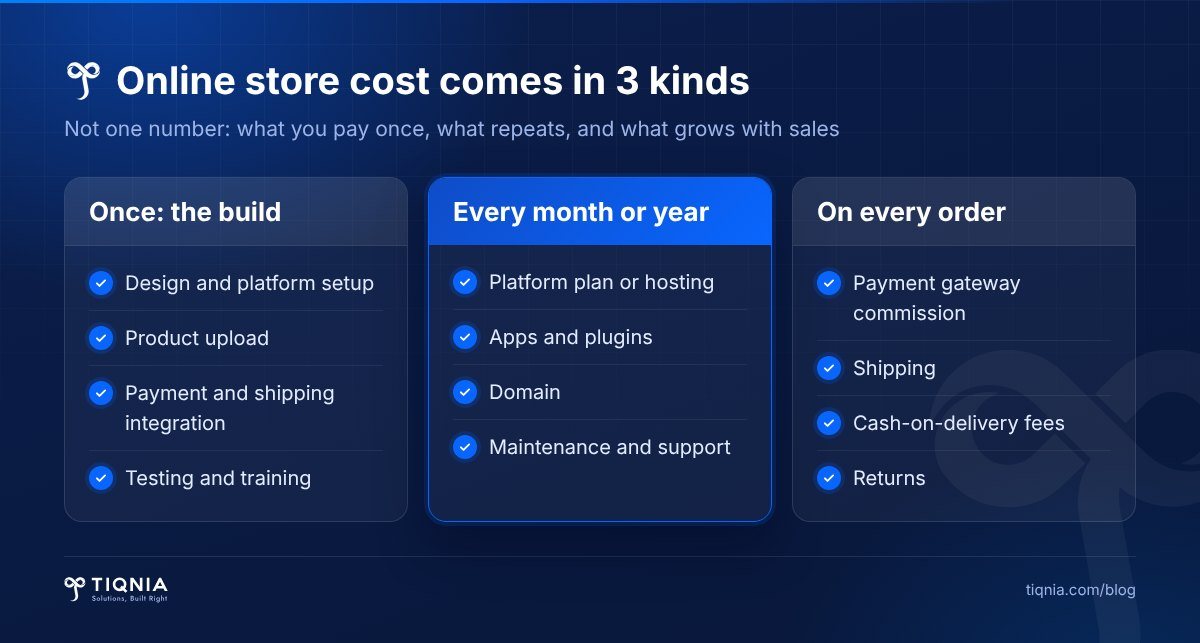
So when you compare two proposals, ask each agency to write out all three groups, not just the build price. To see how a complete store is put together, from checkout to shipping, look at our e-commerce service and hold any quote up against it.
Shopify, WooCommerce or custom: how the platform changes the maths
The platform is the biggest decision in your store's cost. It decides what you pay every month, in which currency, and who carries the maintenance. No platform is cheapest in every case.
According to AfterShip's Egypt e-commerce statistics, WooCommerce and Shopify are almost level in Egypt, each at roughly 38% of the stores the site tracks.
Shopify: a monthly subscription in dollars
The Basic plan is $39 a month billed monthly or $29 billed yearly, and Grow is $105 or $79, according to WebsiteBuilderExpert's Shopify pricing breakdown (May 2026). If you use a payment provider other than Shopify Payments, such as a local gateway, Shopify adds a 2% fee on Basic and 1% on Grow.
The upside: hosting, security and updates are handled for you. The downside: the plan and apps are billed in dollars, and that extra fee sits on top of your gateway's commission.
WooCommerce: free, but not free to run
WooCommerce is a free WordPress plugin, but it needs hosting and setup, as Hostinger's e-commerce cost guide points out. The platform itself charges no transaction fees; you only pay your payment gateway.
The upside: full ownership, freedom to connect any system, and costs mostly in pounds if hosting is local. The downside: solid hosting, updates and security are your job, or the job of whoever supports you.
A custom-built store (Laravel/React)
It makes sense when your selling logic does not exist in ready platforms: wholesale price lists, deep integration with a branch system, or a mobile app alongside the store. It costs the most to build and needs a team that stays with you.
Payment gateways and cash on delivery: the cost on every order
Online payment processing usually costs between 1.5% and 3.5% of each transaction, according to Shoplazza. In Egypt, gateways such as Paymob, Kashier and Fawry set their rate by business type and volume, so get yours in writing before you integrate.
A simple worked example to show the idea: with an average order of EGP 1,000 and a 2.5% rate, EGP 25 comes off every prepaid order. On Shopify Basic with an external gateway, add another 2%. These numbers are for illustration only, not any gateway's actual rates.
- Cards, wallets and InstaPay: money arrives faster and returns tend to be lower, but each payment carries a commission.
- Cash on delivery: still in high demand in Egypt, but it adds collection fees at the courier, and refused deliveries cost you shipping both ways.
The better approach is usually to offer both and nudge customers towards prepaying with a small benefit such as faster delivery, rather than switching off cash on delivery and losing buyers.
Shipping and returns: the line missing from most quotes
Shipping is not part of the build price, but it is a core part of running the store. Couriers such as Bosta and Aramex price by governorate, weight and service type, and their rates change, so ask for a written offer for your business.
What belongs in the build is the technical integration: orders go to the courier automatically, the tracking number reaches the customer, and status updates appear in your dashboard. Without it, your team copies every order by hand.
Also budget for returns, especially if you sell clothing or anything with sizes. A clear returns policy on the site cuts disputes, but it does not remove the cost.
What makes an online store more expensive to build?
The build price follows the real amount of work, and five factors account for most of the gap between quotes:
- Integrations: stock, accounting, in-store POS or CRM. Usually the most expensive item, because it needs heavy testing so the same unit is never sold twice.
- Catalogue size and variants: 50 simple products are not 2,000 products with sizes, colours and photos for each option.
- Design: an adapted theme, or a custom design built around your brand and how your customers buy.
- Languages and markets: Arabic and English, or several countries with different currencies and shipping.
- A mobile app: an app on top of the store roughly doubles the work, because it is a second product to design, publish and update.
Setting up SEO and speed from the start also matters. Product pages with proper titles and written descriptions are what bring visits from Google without paying for ads.
Hidden costs after the store goes live
Hidden costs are the expenses that are not in the build quote but show up in the first year. Plan for them early and your budget stays realistic.
- Theme and plugin renewals: premium WooCommerce themes cost $49 to $129 according to Shoplazza, and many plugins renew yearly.
- Product photos and descriptions: most companies spend more time and money here than they expect.
- Marketing: a store does not sell on its own. A Google and Meta ads budget should be in the plan from day one.
- Maintenance and security: updates, backups, and checking that payments work. A store that is down for a day during a sale costs more than a year of maintenance.
- Currency swings: any dollar subscription can cost more in pounds halfway through the year.
From our experience at TIQNIA: stores that sell, not just stores that ship
TIQNIA is a Dokki-based team that has worked with companies in Egypt and Saudi Arabia for more than 9 years. We build stores on WooCommerce, Shopify and custom code, and connect them to gateways such as Paymob, Kashier, Fawry, InstaPay and Vodafone Cash, and to couriers such as Bosta and Aramex.
The clearest example is 7Pets: 9 branches unified into one sales operation, with an online store, an app and a POS system. In a project like that, most of the work was not the design. It was making stock and orders show one true number everywhere.
We also worked on Cottonil's e-commerce, including its Qatar store, and on Shopify stores such as Ylights, Linah Farms and Mr Beard. You can see them among the projects we delivered.
To be direct: if the lowest price matters most to you, we are probably not the right fit. We suit companies that want a store that works and is supported after launch.
Have a store quote and not sure it covers payments, shipping and integrations? Message us on WhatsApp at +20 101 768 6542 with the line items, and we will tell you what is missing.
Budget your first year in six steps
A sound store budget covers a full year, not launch day. Work through these steps on paper or in a spreadsheet:
- Size it: number of products, branches and languages.
- Pick the platform: Shopify, WooCommerce or custom, based on the integrations you need, not on popularity.
- Write down the build cost: from an itemised written quote.
- Add fixed costs × 12: plan or hosting, apps, domain, maintenance.
- Estimate per-order fees: payment commission + shipping + a returns allowance, multiplied by expected orders.
- Add a buffer: for marketing in the first three months and for currency moves.
The total you get is the number to compare proposals against, not the build price alone.
Questions to ask before you sign a store quote
Any serious e-commerce proposal should answer these in writing. If an agency cannot, that is an answer in itself:
- Are the domain and the platform or hosting account registered in my company's name?
- Which payment gateways and couriers will be integrated, and is that included in the price?
- Who uploads the products, and how many are included?
- Which subscriptions and paid apps will I pay for after launch?
- How many design revision rounds, and what delivery date is written into the contract?
- How long is post-launch support, and what exactly does it cover?
- Will you train my team on the dashboard and order management?
The bottom line
An online store in Egypt does not have one price: there is a build you pay once, fixed costs every month, and fees on every order. Companies that budget all three from the start know when the store will actually turn a profit.
If you want a proposal built around your products and the way you sell, tell us what you need, read more about the WooCommerce and Shopify stores we build, or send us a WhatsApp message and we will come back with a clear scope.
FAQs
How much does an online store cost in Egypt in 2026?
According to GoDaddy's Middle East website cost guide (March 2026), a medium site with an online store can cost up to about EGP 120,000 to build. On top of that come monthly running costs such as a platform plan or hosting, and per-order payment and shipping fees. Figures move with the dollar.
Is Shopify or WooCommerce cheaper in Egypt?
Neither is cheaper in every case. Shopify is a monthly USD subscription, with the Basic plan at $29 to $39 a month and an extra 2% fee if you use a payment provider other than Shopify Payments. WooCommerce itself is free but needs hosting, setup and maintenance.
How much do online payment gateways charge?
Online payment processing typically costs 1.5% to 3.5% of each transaction. In Egypt, gateways such as Paymob, Kashier and Fawry set their rate by business type and volume, so get your rate in writing before integrating.
What are the recurring costs after an online store launches?
The yearly domain, the platform plan or hosting, app and plugin renewals, maintenance and technical support, and a marketing budget. Payment, shipping and returns costs are also charged on every order.
Should my online store offer cash on delivery?
Cash on delivery is still in high demand in Egypt, so switching it off can cost you buyers. The usual best approach is to offer both online payment and cash on delivery, and nudge customers to prepay with a small benefit such as faster delivery.
What makes an online store more expensive to build?
Integrations with stock, accounting or POS systems drive cost the most, followed by catalogue size and variants, custom design, extra languages or markets, and adding a mobile app.
Tell us what you need and the TIQNIA team will come back with a clear plan.