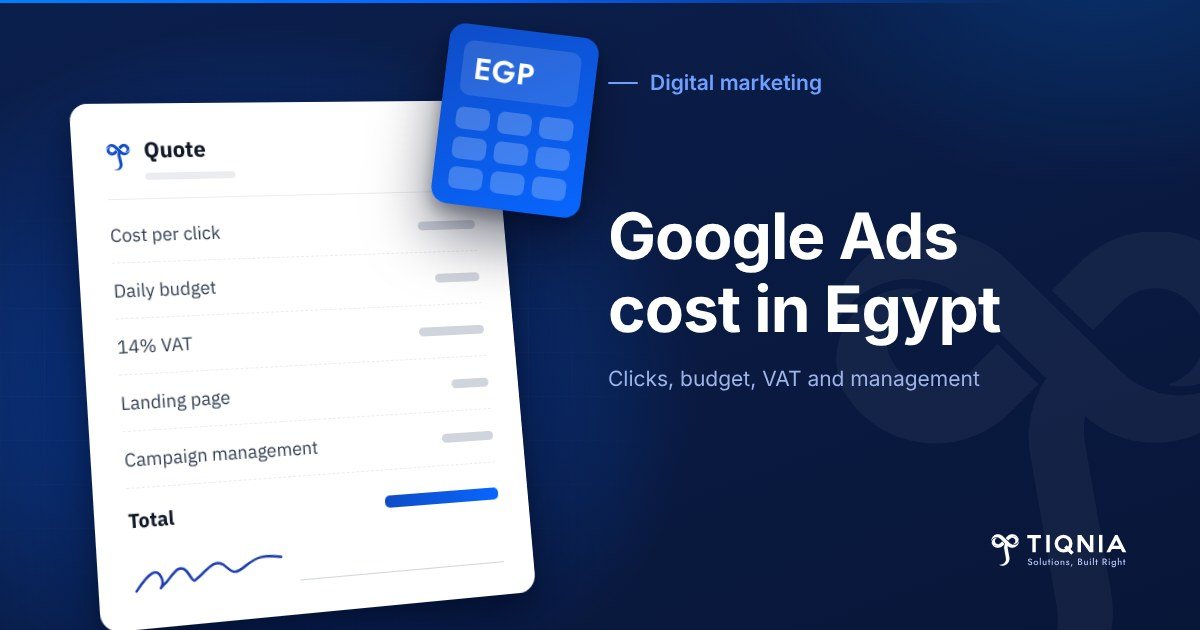
Google Ads cost in Egypt has no fixed price. You set the budget, you pay when someone clicks, and each click's price is set in a live auction based on your industry, keyword, location and ad quality. The real cost to a company is click spend plus 14% VAT, a landing page and someone to manage the account.
The question we hear most is simple: "How much should we put into Google Ads?" There's no single right number. A law firm in New Cairo, a factory in 10th of Ramadan and an online fashion store each pay a very different price per click, and each needs a different number of clicks to win one customer.
Below you'll find how Google prices a click, what pushes the price up, the costs nobody mentions (VAT and account currency), and a practical way to size your own budget before you talk to anyone.
The short version:
- Google doesn't sell packages. You set an average daily budget and pay for clicks.
- A campaign can spend up to twice its daily budget on one day, but never more than the daily budget × 30.4 in a month.
- Egyptian business accounts are charged 14% VAT unless the tax registration details are added.
- Cost per lead (calls, WhatsApp, forms) matters far more than cost per click.
- Size the budget backwards: from the customers you want to the clicks you need.
How much do Google Ads cost in Egypt?
There is no official minimum and no published click price for Egypt. You choose the budget and the auction sets the click price. Anyone who quotes "Google Ads costs X a month" without asking about your industry, keywords and target area is giving you a number with nothing behind it.
What you can know upfront is an estimate for your own keywords. Keyword Planner, inside every Google Ads account, shows a top-of-page bid range per keyword, in EGP if your account is in EGP, for Egypt or a single governorate. It's the closest thing to a real number, and it changes over time.
The money that actually leaves your company has four parts:
- Click spend: what goes straight to Google.
- Tax: 14% VAT on accounts with an Egyptian business address (details below).
- Landing page: the page your ad sends people to, which also affects the price of each click.
- Management: someone who knows what they're doing, reviewing keywords, bids and reports every week, in-house or an agency.
If the campaign comes with a new site, it's worth reading what drives the cost of a company website, because the site is what turns a click into a customer. If you'd rather have a team run it from day one, here's our digital marketing service.
How does Google decide the cost per click?
Cost per click (CPC) is what you pay when someone clicks your ad, and it's set in an auction that runs on every search. You set the most you're willing to pay, but you usually pay less, depending on competitors and your position.
The auction and Ad Rank
Each search triggers an auction that decides which ads show, in what order, and whether any show at all. Position isn't bought with money alone. Google also weighs ad quality, how relevant the ad is to the search, the landing page experience and context such as device, location and time.
Why a competitor can pay less for the same keyword
A clearer ad and a better-matched page raise your rating, so you can hold a good position with a lower bid. This is the one thing every business owner should take away: ad and landing page quality lower your click price, not just raise your sales. Spending heavily on a weak ad is an extra tax you pay without noticing.
What pushes Google Ads costs up in Egypt?
Click prices rise with competition for the same keyword and with how much a customer is worth to advertisers. These are the six factors we see matter most in the Egyptian market:
- Industry: where a customer is worth a lot (legal, real estate, healthcare, B2B services), competition is higher and clicks cost more.
- Buying intent: "AC maintenance company in Nasr City" costs more than "how to clean an AC", because the first searcher is ready to pay now.
- Location: Greater Cairo is a different auction from a smaller governorate, and targeting the Gulf from Egypt is a different market entirely.
- Quality and landing page: a slow or unrelated page raises your costs.
- Seasons: Ramadan, Eid and back-to-school bring more advertisers into certain categories and heat up the auction.
- Campaign type: Search, Performance Max, Display and YouTube are each priced and measured differently.
One point that's specific to Egypt: people search in colloquial Arabic, in Franco-Arabic and in English. "سعر تركيب مطبخ", "مطابخ ألوميتال" and "kitchen design cairo" are different keywords with different prices. A campaign that covers all three sensibly often finds cheaper clicks than one written only in formal Arabic.
Can Google spend more than your daily budget?
Yes on a single day, no across the month. According to Google's own page on average daily budgets, a campaign can spend up to twice its daily budget on a busy day, but the monthly total won't exceed the daily budget × 30.4.
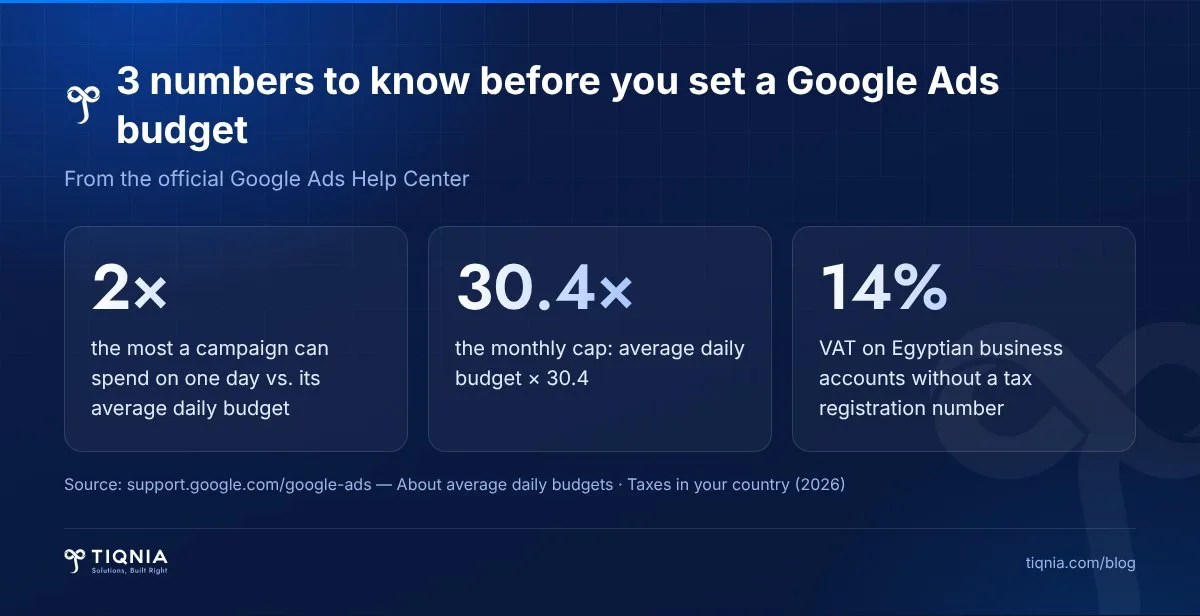
So a daily budget of EGP 1,000 means a monthly cap of about EGP 30,400. One day may spend 2,000 and another far less. Google's page on overdelivery states you'll never pay more than these spending limits, and any excess is credited back.
Why this matters to a business owner
Plenty of people check a single day's report and panic. Plan by the month instead: pick the monthly figure you're comfortable with, divide by 30.4, and use that as the daily budget. If you pause mid-month, you only pay for the days that ran.
VAT and currency: the costs nobody mentions
Two items surprise many companies on their first invoice: VAT and the account currency. Both can change your real cost noticeably, so plan for them from the start.
14% VAT on Egyptian business accounts
Google's tax help page says that since 1 July 2024, a 14% VAT is charged on Google Ads accounts with an Egyptian business address, unless you add your Tax Registration Number (TRN) and Unique Identification Number (UIN) in the payment settings. An EGP 10,000 budget becomes EGP 11,400 without those details.
If your company is VAT-registered, ask your accountant to check these details and add them before you start, and to advise on how they're treated in your books. It's an accounting decision, not a marketing one.
Pay in EGP or USD?
The account currency is chosen when the account is created, and changing it later usually means opening a new account. If you pay with an Egyptian bank card, paying in EGP spares you exchange-rate swings and card limits on international payments. If you also target Saudi Arabia or the Gulf, talk to your accountant before you decide.
How to calculate a Google Ads budget for your company
Work backwards. Start with the number of customers you want per month, convert that to enquiries, then to clicks, and multiply by the expected CPC from Keyword Planner. That ties the budget to a goal instead of a guess.
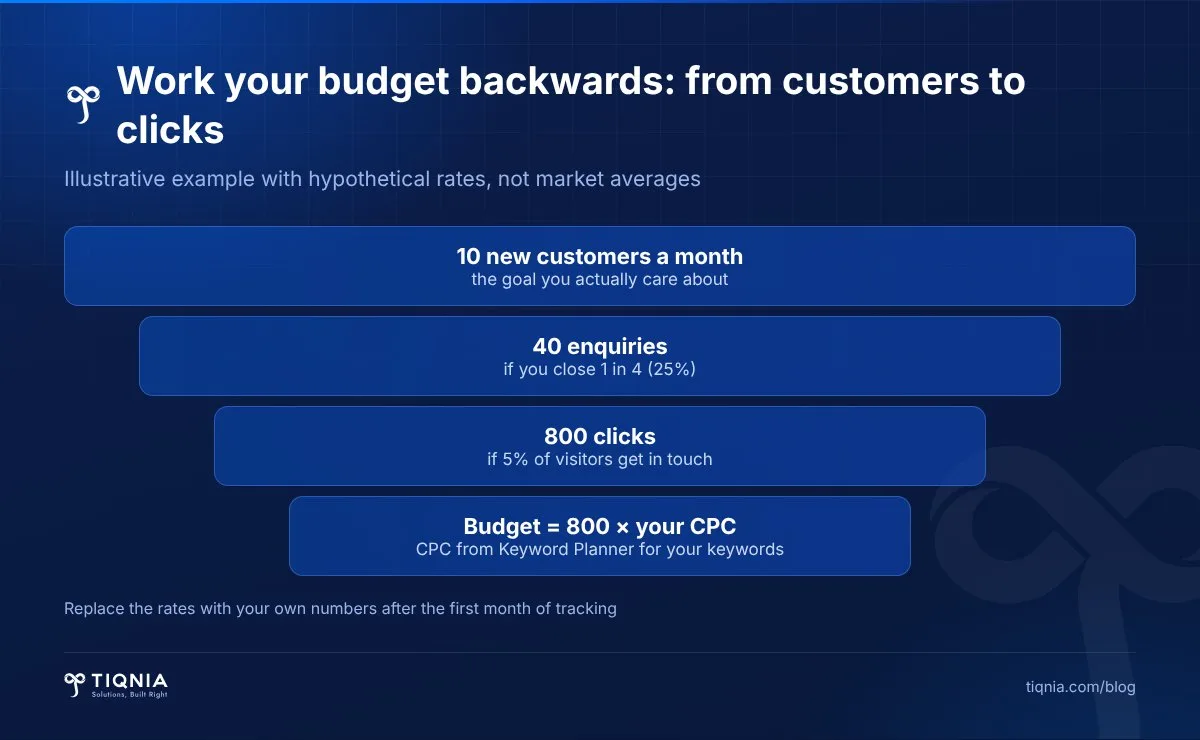
A worked example with hypothetical rates
Say you want 10 new customers a month and your sales team closes 1 in 4 enquiries (25%). You need 40 enquiries. If 5% of visitors get in touch, you need 800 clicks. Multiply 800 by the average CPC for your keywords, and that's your monthly budget estimate before VAT.
Those rates (25% and 5%) are only for illustration. The first month of a campaign exists to give you your real rates, and from then on the maths gets precise. If the total is more than you can spend, narrow the area or the services rather than spreading a small budget thinly across everything.
Cost per lead matters more than cost per click
The number that matters to a business owner is cost per lead (CPL): total spend divided by the calls, messages and forms you actually received. A EGP 5 click that brings nobody costs more than a EGP 40 click that brings a customer.
For reference only: WordStream's 2026 Google Ads benchmarks (US search campaigns, April 2025 to March 2026) put the average cost per lead across industries at $66.69, legal services at $131.63 and real estate at $102.51. These are US figures and won't transfer to Egypt, but they show the point: cost per lead can differ several times over between industries.
How to measure leads properly
- Calls: a call button in the ad and on the page, tracked as a conversion.
- WhatsApp: every tap on the WhatsApp button recorded as a conversion, because many Egyptian buyers would rather message than call.
- Forms: a thank-you page after submission, or a Google Analytics 4 event linked to the account.
- Actual sales: your team records where each customer came from, so you know which keywords bring deals, not just enquiries.
Without conversion tracking, a campaign runs in the dark: you'll know what you spent and not what came back.
The full cost: ads, management and a landing page
The Google budget is only part of the cost. A campaign that delivers also needs someone managing it weekly and a landing page built for the ad. Neither has to be expensive, but both have to exist.
What good management includes
- Keyword research in colloquial Arabic and English, plus a negative keyword list updated weekly.
- Conversion tracking set up before the first pound is spent.
- Writing and testing ads, and adjusting bids based on results.
- A clear report showing leads and cost per lead, not just clicks and impressions.
Management fees in the market vary widely: a percentage of spend, a fixed monthly fee, freelancers or agencies. What you should ask is who actually works on the account, how often, and whose name the account is in. The ad account must belong to your company, so the data and history stay with you.
And plainly: if your budget is too small to buy enough clicks to learn from, you may be better off starting with your Google Maps listing and SEO, and coming back to ads when you're ready.
What we've learned running Google Ads for companies
At TIQNIA, a technology company in Dokki working with businesses in Egypt and Saudi Arabia, we're a Google Partner and a Meta Partner, and we've delivered work for 350+ companies over 9 years. That has shown us the same mistakes repeating in many of the accounts we take over.
The three we see most: no conversion tracking at all, ads that send people to the home page instead of the service page, and keywords so broad they bring clicks from job seekers or people looking for free information. Fixing these usually makes a difference before a single extra pound goes into the budget.
Our process doesn't change: understand your business and the customer you want, set up tracking and the page, launch, then a written update every week and a monthly review with one named owner. You can browse our portfolio of projects across different industries.
If you'd like a sensible budget for your industry before you spend anything, message us on WhatsApp with your industry and target area.
Before you spend your first pound: a checklist
These steps take a day or two and save weeks of wasted spend:
- Pick one clear goal: calls, WhatsApp messages or quote requests.
- Open the account in your company's name and choose the currency after checking with your accountant.
- Add your tax details (TRN and UIN) if your company is registered.
- Pull CPC estimates from Keyword Planner for your keywords and area.
- Calculate the budget backwards from the customers you want.
- Prepare a landing page per service, fast on mobile, with call and WhatsApp buttons.
- Turn on conversion tracking and test it before launch.
- Build a negative keyword list from day one.
- Agree on a weekly report that shows cost per lead, not just clicks.
The bottom line
What Google Ads cost you comes down to your own decisions: keywords, location, page quality and tracking. Plan by the month, include VAT, and measure cost per lead rather than cost per click. If you want a team to size it with you and run it, discuss your project with us or send us a WhatsApp message, and see how we handle Google and Meta ads management.
FAQs
Is there a minimum budget for Google Ads in Egypt?
Google doesn't sell fixed packages; you set an average daily budget and can change or pause it anytime. The budget still needs to buy enough clicks to learn from, or the campaign won't give you useful data.
Can Google Ads spend more than my daily budget?
Yes, on a single day a campaign can spend up to twice its average daily budget, but the monthly total won't exceed the daily budget × 30.4, according to Google Ads Help.
Is there VAT on Google Ads in Egypt?
Yes. Since 1 July 2024, Google charges 14% VAT on Google Ads accounts with an Egyptian business address, unless you add your Tax Registration Number (TRN) and Unique Identification Number (UIN) in the payment settings.
How do I find the cost per click in my industry?
Use Keyword Planner inside your Google Ads account. It shows an estimated top-of-page bid range per keyword for Egypt or a single governorate. It's an estimate; the actual price is set in the auction and moves with competition and seasons.
What is the most important number in a Google Ads report?
Cost per lead: total spend divided by the calls, WhatsApp messages and forms you actually received. Cost per click alone can mislead, because a cheap click that brings nobody is the most expensive one.
Whose name should the ad account be in?
Always your company's, even if an agency manages it. That way the campaign data, history and invoices stay yours if you change teams.
Tell us what you need and the TIQNIA team will come back with a clear plan.