Good construction company website design is built for the person who evaluates you before inviting you to bid. That means a page for every project with real data, a company profile and prequalification file one click away, certificates and classification on display, Arabic and English versions if you work in the Gulf, and a direct line to your tenders team.
Most results for this search are freelancer listings and "website in a week" offers. But a contractor's site is not a business card. Owners, consultants and procurement officers open it while building a shortlist, and they decide within minutes whether you make it into the comparison sheet.
Below: who actually visits a contractor's website, the pages you need (with a sample sitemap), how to present projects and certificates, what helps Google find you, the mistakes we see most, and a checklist you can use with any web team.
If you only have a minute:
- A contractor's website is a prequalification tool, not a photo gallery.
- Every project gets its own page: type, location, scope, duration and your role.
- The company profile and prequalification PDF should be one click away.
- Show certificates and classification as they are, with issuer and dates.
- If you target Saudi Arabia or the Gulf, build the Arabic and English versions properly from day one.
Who actually visits a construction company website?
A construction company website serves three kinds of visitors, and each is looking for something different. Design for only one of them and you lose the other two.
The owner or developer
They want proof that you have delivered projects like theirs in size and type, and that you hand over on time. They look at projects, photos and client names before anything else.
The consultant and procurement officer
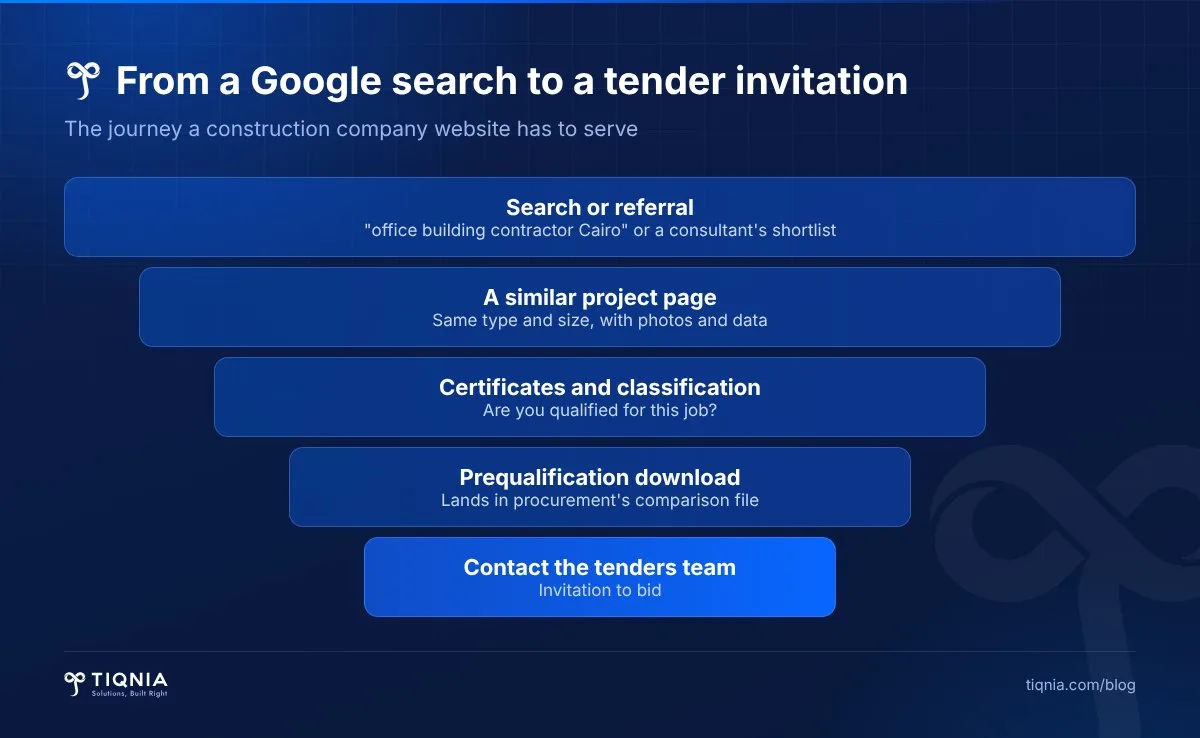
This is the person building the shortlist. They need facts for a comparison sheet: specialty, classification, certificates, similar experience and a way to request your prequalification file. If they can't find it quickly, they move on to the next name.
The main contractor or supplier
If you work as a specialist subcontractor, main contractors search for you by name or trade. Suppliers and engineers who want to work with you visit too, which is why careers and supplier registration pages belong on the site.
Construction company website design: which pages do you need?
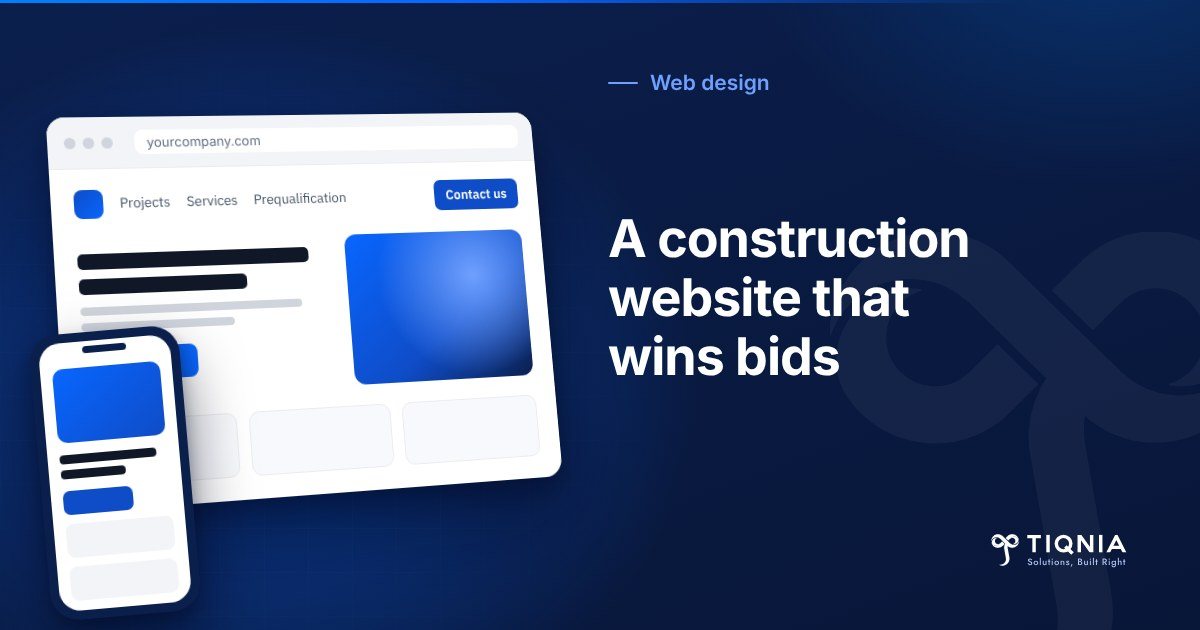
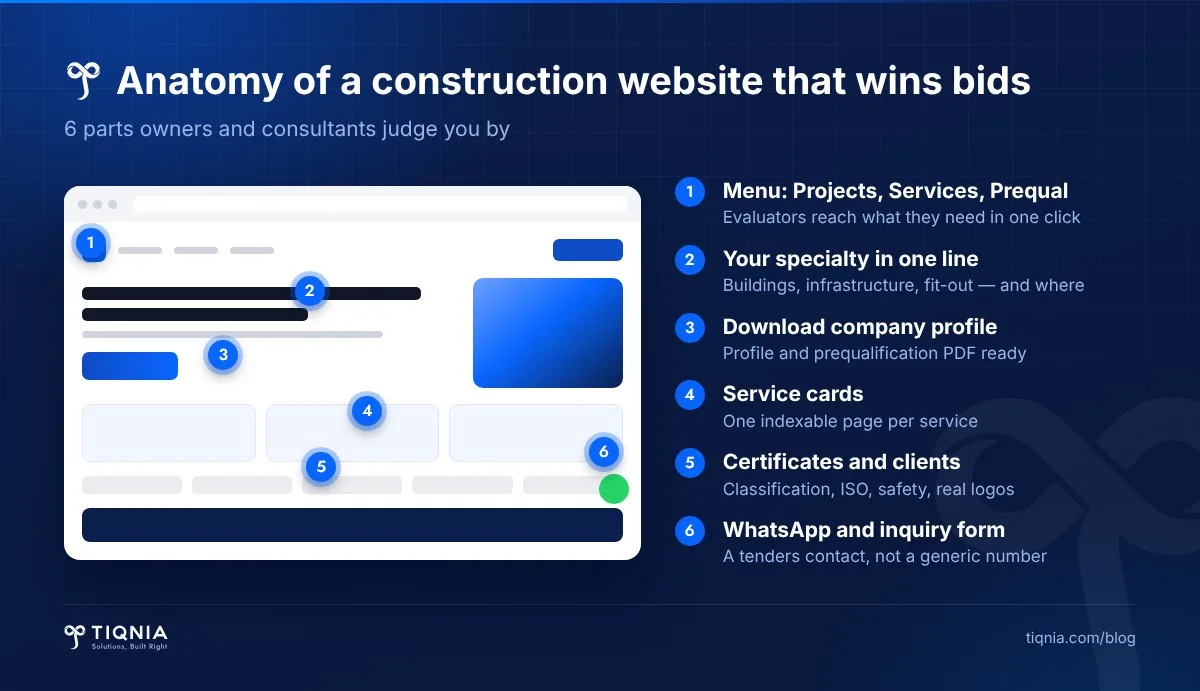
A construction company website needs eight core pages: Home, About, Services, Projects, Certificates and classification, Prequalification, Careers and suppliers, and Contact. That is the minimum that lets an evaluator answer their own questions without calling you. It's also the base we start from in our company website service before adding what your business needs.
A sample sitemap you can start from:
- Home: your specialty in one line, real numbers, three flagship projects and a profile download button.
- About: founding year, leadership, structure, quality and safety policy.
- Services: one page per service (buildings, infrastructure, MEP, fit-out and so on).
- Projects: filters by type, location and status (completed or ongoing).
- Certificates and classification: registration or classification grade, ISO, safety certificates.
- Prequalification: profile PDF plus a form to request the full prequalification file.
- Careers and supplier registration: two separate forms, so they don't flood the sales inbox.
- Contact: tenders contact, WhatsApp, and your address on a map.
How should a contractor present projects?
The projects section is the strongest part of any contractor's website, as long as each project has its own page with data, not just an album. Photos alone say "we build things". Data says "we built something like what you need".
What to write for every project
- Project type and location (an office building in New Cairo, a factory in 10th of Ramadan, villas in Riyadh).
- Scope and your role: main contractor, subcontractor, or design and build.
- Area, floors or length, whatever number shows the scale.
- Start and handover year, or current status if ongoing.
- Owner and consultant, only with their permission.
Photos and video
Real site photos beat any stock image, and progress shots build more trust than the final handover photo alone. Give every image a descriptive file name and alt text. Google's image SEO guidance says alt text, descriptive file names and the text around an image all help Google understand it.
Client confidentiality
Some owners won't allow their name or certain photos online. Don't drop the project; describe it instead: "Office complex for a telecom company, 12 floors". You keep the proof without breaking an agreement.
The company profile and prequalification file most sites forget
A prequalification file is the set of documents an owner or consultant asks for to decide whether you can bid on a project. If your website makes that step easy, you save a procurement officer a day of chasing, and they remember it.
Set up two separate things:
- A short profile PDF that downloads directly, no sign-up: who you are, services, key projects, certificates. Keep it light enough to open on a phone.
- A full prequalification file requested through a short form (name, organization, project). You learn who is evaluating you, and you get a named lead instead of an anonymous visit.
Update both whenever you finish a project or renew a certificate. A prequalification file dated three years ago tells the reader the company has stood still.
Certificates and classification: how to prove you are a serious contractor
The fastest way to earn trust on a contractor's site is a real certificates page: each certificate with its image, issuing body and validity date. Evaluators search for these by name, so give them their own page and link it from the homepage.
- In Egypt: your registration and grade with the Egyptian Federation for Construction and Building Contractors, since the grade defines the size of work you can bid for.
- In Saudi Arabia: your contractor classification certificate and grade if you hold one, plus any registrations with the bodies you work with.
- Quality and safety: the ISO certificates you actually hold and your health and safety policy.
- Clients and partners: real logos with permission, plus completion certificates or reference letters you're allowed to publish.
Skip "the best construction company in Egypt". Nobody believes it, and a dated certificate says more.
Arabic and English: why a contractor's site needs both
If you target projects in Saudi Arabia or the Gulf, or deal with international consultants and developers, an English version is not optional. Much of the tender paperwork and correspondence on larger projects runs in English, and the decision-maker may not read Arabic.
Build both languages as real versions, not machine translations of the same page. Each version needs its own headings and the terms people actually search for, and the two should be linked so Google shows each visitor the right language, as explained in Google's documentation on localized versions (hreflang).
SEO for construction companies: how clients find you on Google
SEO for a contractor means your pages appear when someone searches for your service and location, such as "fit-out contractor Cairo" or "infrastructure company Jeddah". It comes from one page per service, one page per project, and accurate company data.
A page for each service and each area you work in
A single "Our services" page won't rank for any specific search. Split each service into its own page with its own title and description, and name the cities you actually work in.
Google Business Profile
Google says local results are ranked mainly on relevance, distance and prominence, according to the Google Business Profile help page. A complete profile with the right category, photos and genuine reviews makes a difference, especially for fit-out and maintenance contractors.
Structured data
LocalBusiness or Organization structured data tells Google your company name, address, hours and phone in a clear format, as described in Google's structured data documentation. It also helps AI assistants understand who you are.
Speed and mobile: lots of photos without a heavy site
Contractor websites get slow because of photos, and that hurts both visitors and SEO. The fix is compressing images, serving modern formats like WebP, and lazy-loading gallery images instead of loading 60 photos at once.
Google measures page experience with Core Web Vitals. According to web.dev, a good result is Largest Contentful Paint (LCP) within 2.5 seconds, Interaction to Next Paint (INP) of 200 milliseconds or less, and Cumulative Layout Shift (CLS) of 0.1 or less. Run your current site through PageSpeed Insights and compare.
Remember that the site engineer and the consultant in their car will probably open your website on a phone. Call, WhatsApp and profile download buttons must be obvious on a small screen.
What we've learned building company websites at TIQNIA
At TIQNIA, a Dokki-based team working with companies in Egypt and Saudi Arabia for more than 9 years, we've delivered websites for 350+ companies. The lesson: a large company's website usually fails for one reason, content. Photos are scattered, project data sits with a site engineer, and the profile is out of date.
So we start with discovery before design: we gather the project list and its data, the certificates and the profile with you, then design the pages around the people evaluating you. Our company websites ship in Arabic and English, with a full admin panel (so you can add a new project yourself) and training, a delivery date written into the contract, and 6 months of support after launch. You can browse projects we delivered, including Retal and Arch Builders.
If the lowest price is your top priority, we're probably not the right fit. If you want a website that works as an always-open prequalification file, message us on WhatsApp and tell us your specialty.
Common mistakes on construction websites, and a checklist before you start
Most contractor websites we review make the same mistakes, and most are easy to avoid if you know them up front.
Mistakes we see often
- A photo gallery with no information about any project.
- A 40 MB profile PDF that crashes on a phone.
- The newest project posted years ago, so the site looks abandoned.
- A general phone line answered by someone who knows nothing about tenders.
- A machine-translated English version that hurts you with foreign consultants.
- The domain and hosting registered to the web agency, not to you.
A checklist you can use today
- List your 10 to 15 strongest projects, each with type, location, size, duration and your role.
- Collect real photos for each one and ask clients for permission to name them.
- Scan every certificate and note its expiry date.
- Update your profile and make a light version for download.
- Decide who receives tender, supplier and careers inquiries.
- Ask any web team: can I add projects myself? Will the site be in my name? Are both languages linked correctly? Is there support after launch?
If you're still comparing agencies, read how to choose a web design company, and if you're budgeting, see what drives website design cost in Egypt.
The bottom line
A strong construction company website does the work of your business development and tenders team at once: it shows projects like the one the client needs, proves your qualifications with real certificates, and makes it easy to get your file and reach you. If you'd like us to build that for your company, tell us what you need, see how we build company websites, or reach us on WhatsApp and we'll come back with a clear plan.
FAQs
What pages should a construction company website have?
Home, About, Services, Projects, Certificates and classification, Prequalification, Careers and supplier registration, and Contact. Each project and each service should also have its own page.
What should a contractor show on each project page?
Project type and location, scope and your role, a number that shows scale such as area or floors, start and handover year, and real photos from different stages. Name the owner and consultant only with their permission.
Should I put my full prequalification file on the website?
Offer a short company profile as a direct download, and let people request the full prequalification file through a short form. It's easier for evaluators and tells you who is interested.
Does a construction website need Arabic and English?
Yes if you target Saudi Arabia or the Gulf or work with international consultants. Write both as real versions linked to each other, not machine translations.
How can a construction company show up on Google?
With one page per service and area, one page per project, a complete Google Business Profile, structured data for the company, and a fast mobile site.
How much does a construction company website cost?
It depends on the number of projects and pages, languages, the admin panel and how much content needs preparing. At TIQNIA we scope the offer after understanding your needs; our article on website design cost in Egypt explains the main cost drivers.
Tell us what you need and the TIQNIA team will come back with a clear plan.